

Alligator Snapping Turtle
At a Glance
The Alligator Snapping Turtle is the largest freshwater turtle in North America and one of the heaviest in the world, with males occasionally exceeding 80 kg. Found exclusively in river systems that drain into the Gulf of Mexico across the southeastern United States, this prehistoric-looking species is famous for the worm-shaped lure on its tongue that it uses to bait fish into its gaping jaws. Once heavily harvested for its meat, the species was reclassified as Endangered by the IUCN in 2025 and continues to decline across much of its range.
Other Names People Call Me
Identification
Males are dramatically larger than females — a pattern that's actually unusual among turtles. Males commonly reach 50 cm or more in carapace length and can exceed 80 cm, while females rarely surpass 57 cm. The heaviest verified captive specimen weighed 113 kg, though wild individuals typically range from 8 to 80 kg.
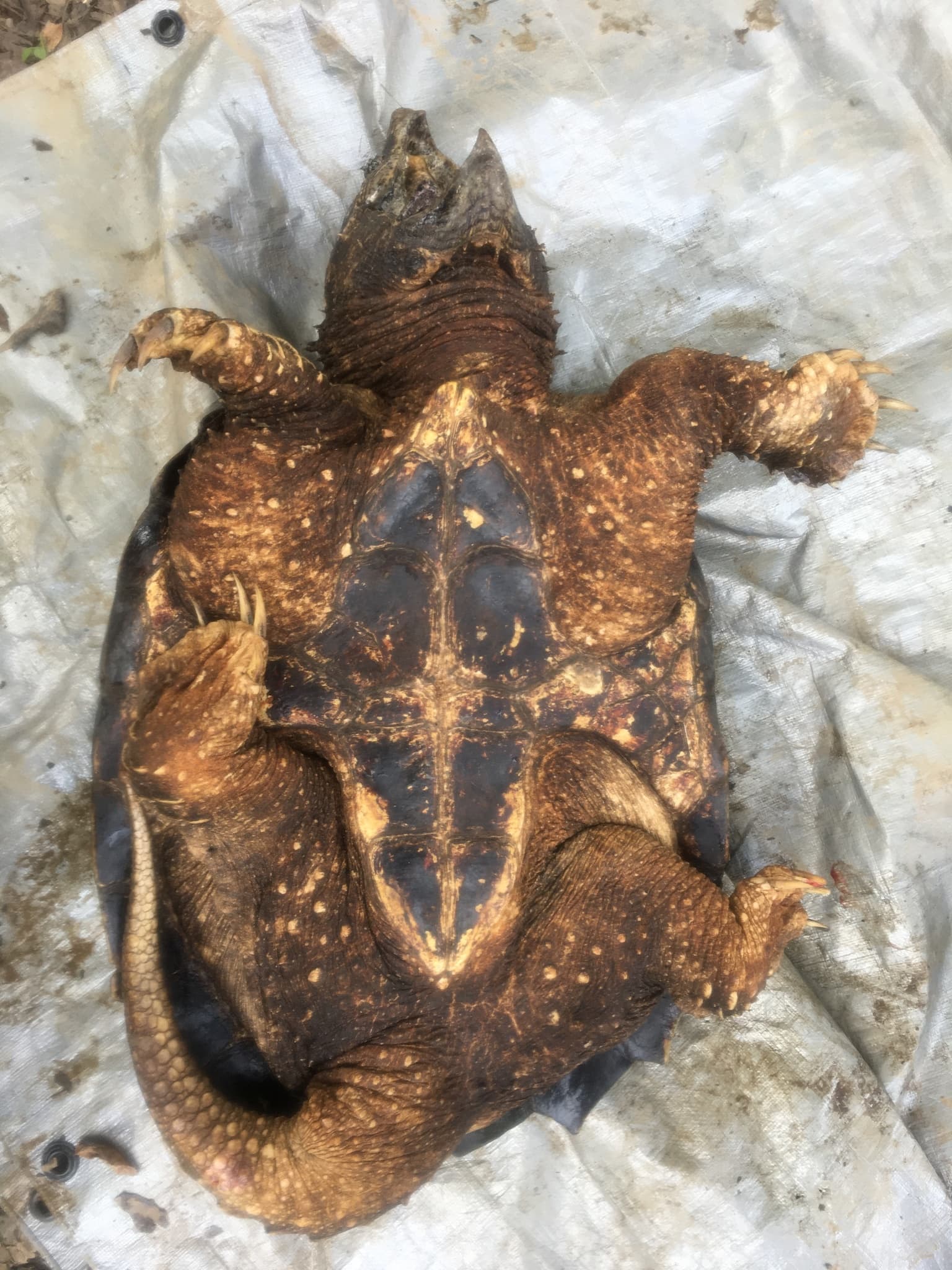
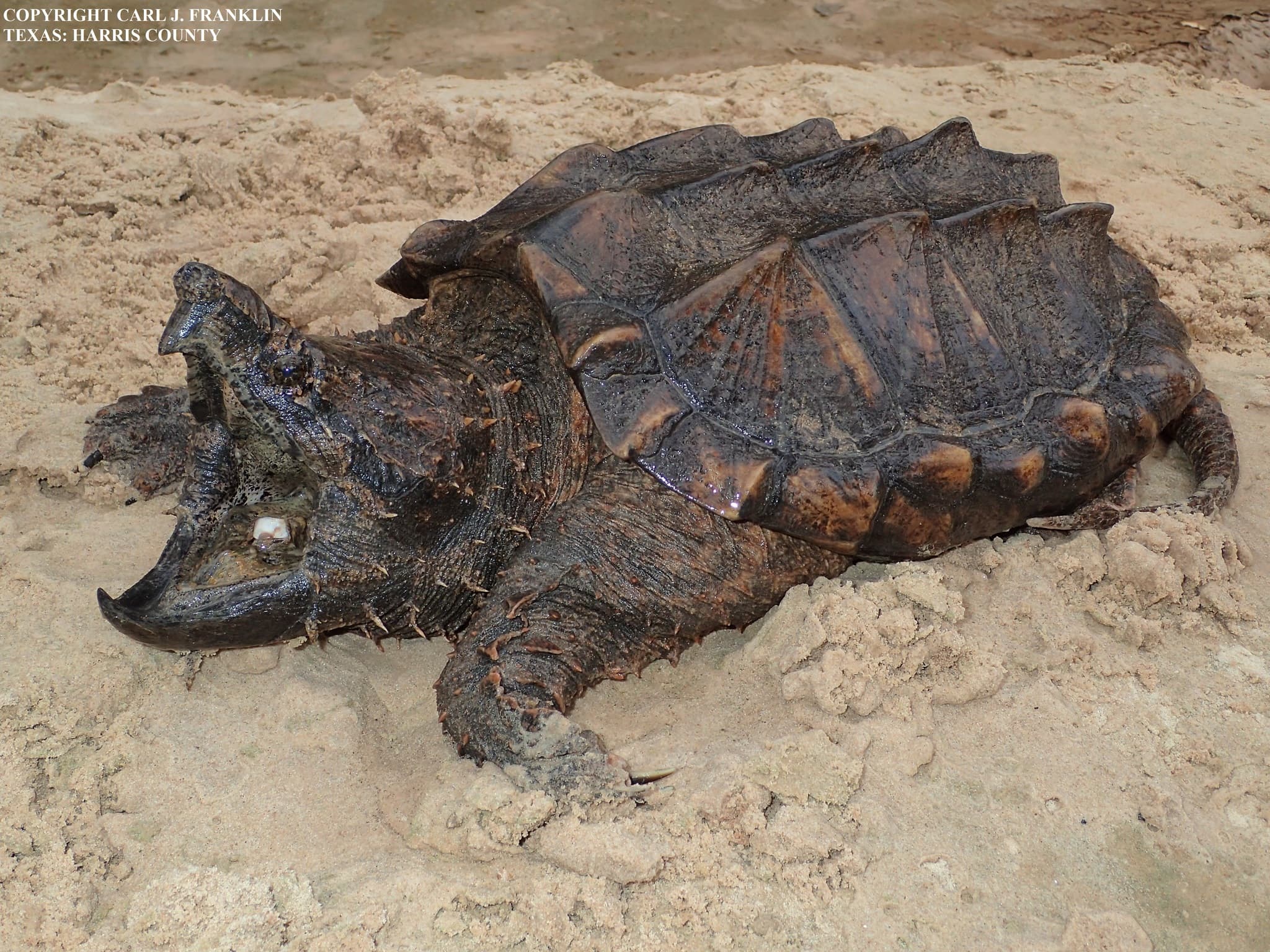
The shell is unmistakable: dark brown with three prominent keeled ridges running the length of the carapace, studded with knob-like spikes that give the turtle a distinctly dinosaur-like appearance. These spikes gradually flatten with age. A row of small supramarginal scutes — found in no other living turtle — sits between the marginal and costal scutes along each side of the shell. The plastron is narrow and cross-shaped, leaving much of the body exposed underneath.
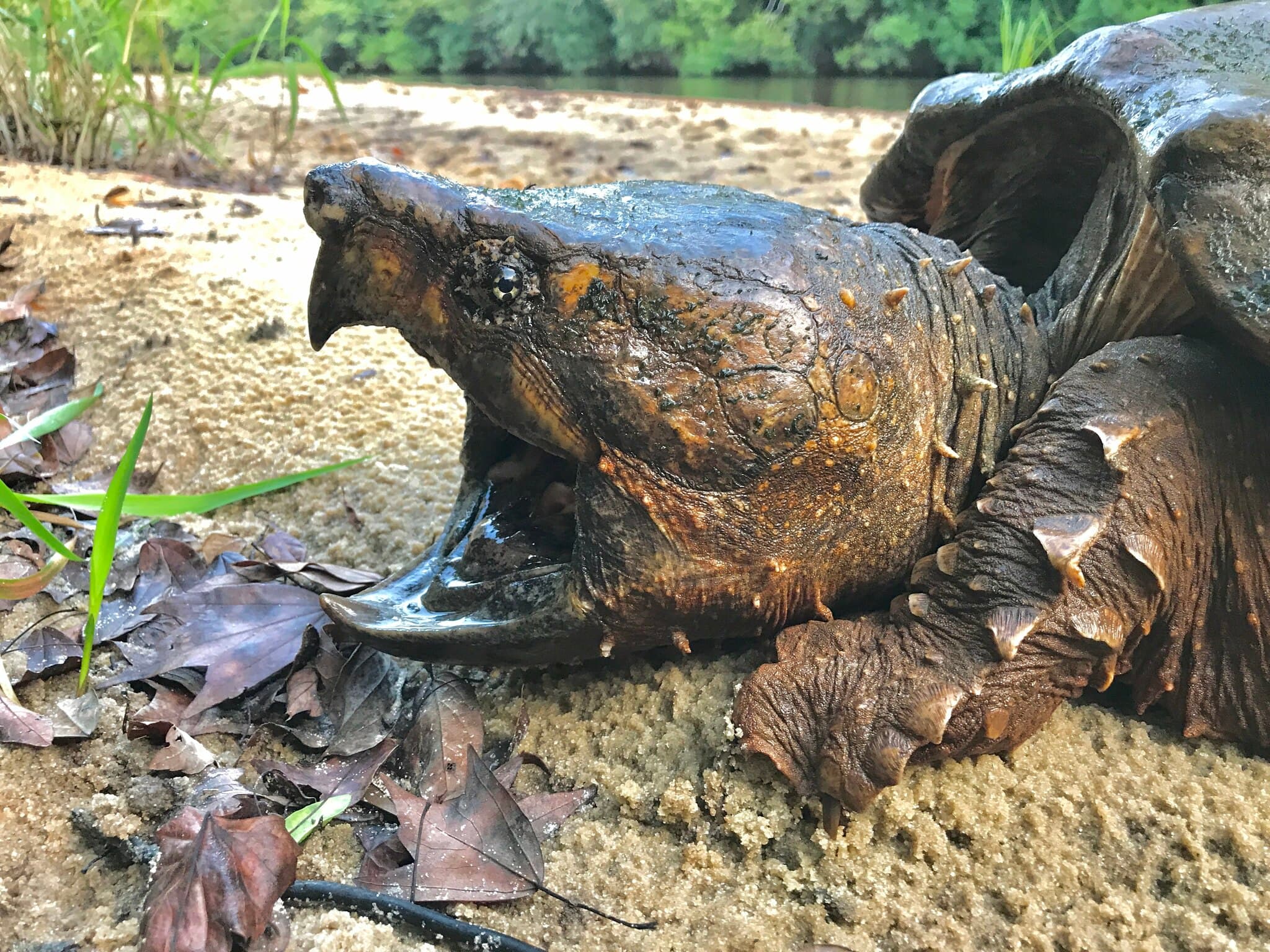
The head is massive and cannot be fully retracted into the shell. Both jaws are strongly hooked. Radiating yellow patterns surround the eyes, helping camouflage the turtle underwater, and a fringe of fleshy filaments gives the eyes an "eyelash" effect. The overall color is solid gray, brown, black, or olive-green, and wild individuals are often coated in algae, further enhancing their camouflage.
Hatchlings look like miniature adults, measuring 34–45 mm in carapace length and weighing around 18 g. They're dark brown with roughened carapaces, long slender tails, and occasionally show lighter mottling on the skin. Unlike the common snapping turtle, hatchling alligator snappers have prehensile tails.
Best estimate of natural adult weight based on turtles caught in the wild.
The male is generally larger than the female.
These are best estimates based on what has been observed and recorded.
Physical Features
Features shown are for Adult Males (reference). Look for the variant icon to see how a feature differs by sex or life stage.
Alligator Snapping Turtle
Macrochelys temminckii
Related Species | Quick Add
Distribution
This species is endemic to the United States, occurring exclusively in river systems that drain into the Gulf of Mexico. Its range extends from the Florida Panhandle west to East Texas, and north through the Mississippi River Valley into southeastern Kansas, Missouri, southeastern Iowa, western Illinois, southern Indiana, and western Kentucky and Tennessee. The species occurs in all Gulf Coast states from Florida to Texas, with Louisiana, Mississippi, Alabama, Arkansas, and Georgia all supporting populations of varying sizes.
The 2014 taxonomic revision separated the Suwannee River populations in Florida and Georgia as a distinct species (M. suwanniensis). This means M. temminckii, as currently defined, ranges from the Choctawhatchee River drainage in Florida westward through all Gulf drainages to the San Antonio River in Texas.
Habitat
Alligator snapping turtles are among the most aquatic of all turtles — only nesting females regularly venture onto land. They inhabit the deeper portions of large rivers, major tributaries (especially spring-fed sections), canals, impounded lakes, oxbow lakes, bayous, and swamp forest floodplains. The ideal habitat features abundant structural cover: undercut banks, limestone ledges, scour holes, large woody debris like submerged logs and root balls, and dense canopy cover overhead.
Floodplain swamp forests with bald cypress and tupelo, connected by deep, flooded channels, represent the optimum habitat. The water is often tannin-stained or turbid with suspended silt — conditions that suit a camouflage-dependent ambush predator perfectly. Adults favor deep water, while hatchlings and juveniles are typically found in smaller streams. The species can tolerate some brackish water, though saltwater crossings between river drainages appear to be extremely rare.
Habitat Systems
Freshwater, Terrestrial
Habitat Types
Inland Wetlands
Predators
Adult alligator snapping turtles have no natural predators other than humans. Their massive size, armored shell, and powerful jaws make them essentially invulnerable once fully grown. Eggs and hatchlings are a different story — raccoons are the primary nest predators and can devastate nesting success. Hatchlings and small juveniles face predation from large fish, river otters, wading birds, and raccoons. The phorid fly (Megaselia scalaris) can infest nests, with larvae damaging eggs and killing emerging hatchlings. Fire ants (Solenopsis invicta) may also threaten pipping and emerging hatchlings.
Habitat Systems
Freshwater, Terrestrial
Habitat Types
Inland Wetlands
Behavior
Hibernation
Alligator snapping turtles don't truly hibernate, but their activity drops significantly during the colder months. They remain in the water year-round and can tolerate fairly cool temperatures, though they become less active in winter. On warm winter days, they may still forage along the bottom and shoreline. The species thermoregulates primarily by adjusting its depth in the water column rather than basking, and aerial basking has been documented only once.
Diet
These turtles are opportunistic carnivores with surprisingly varied diets. They're perhaps best known for their unique fishing technique: lying motionless on the bottom with jaws agape, wriggling a pink, worm-shaped lure on their tongue to attract fish into striking distance. The camouflaged interior of the mouth — grayish-brown with black speckles rather than the typical turtle pink — completes the ambush setup.
But lure fishing is primarily a juvenile strategy. As the turtles grow, the lure becomes proportionally smaller and less conspicuous, and adults shift to more active foraging, particularly at night. A Louisiana study found that the majority of stomach contents by volume were actually oak acorns, with fish being the most frequently eaten item but contributing only about 7% by volume. Other prey includes other turtles, mollusks, crayfish, snakes, frogs, aquatic birds, and even small mammals like raccoons, muskrats, and armadillos that venture too close to the water's edge. They've even been known to take small American alligators. As seed dispersers of oak trees, these turtles may play an important ecological role — ingested acorns have been shown to germinate faster after passing through their digestive system.
Nesting
Mating occurs yearly, in early spring in the southern part of the range and later spring farther north. Males mount females from behind, grasping the shell with all four feet. Courtship involves considerable sniffing and occasional biting. About two months after mating, females make one of their rare overland trips to construct a nest.
In Florida, the nesting season runs from late April through mid-May, with females preferring warm, humid early mornings, particularly following rain. Nests are typically within 20 m of water but can be as far as 200 m during dry years. Females produce a single clutch per year of 8–52 eggs (mean of about 35 in well-studied Florida populations), and some females skip years entirely. The nearly round eggs weigh about 26 g and measure 32–41 mm in diameter.
Incubation takes 100–140 days, with most eggs hatching in about 105–110 days. Sex is determined by incubation temperature: 25–27°C produces mostly males, while 29–30°C yields only females. Hatchlings emerge in late summer to early fall and do not overwinter in the nest.
Unique Traits and Qualities
The vermiform tongue lure is the headline feature — no other living turtle has anything like it. This pink, worm-shaped appendage wiggles convincingly on the floor of a camouflaged mouth, turning the turtle into a living fishing trap. The interior of the mouth is uniquely pigmented in grayish-brown with black speckles rather than the typical pink, completing the illusion.
But the superlatives don't stop there. This is the largest freshwater turtle in North America and among the heaviest in the world, with only some Asian giant softshell turtles reaching comparable sizes. The bite force is formidable, ranging up to 1,872 Newtons in large individuals — enough to cleanly sever human fingers and bite through a broom handle. The supramarginal scutes along each side of the carapace are found in no other living turtle species, though they occur in some long-extinct fossil turtles. And these animals are remarkably long-lived: the oldest captive individual survived over 80 years, and wild individuals are believed capable of reaching 80–120 years or more.
Conservation
Status
The Alligator Snapping Turtle was reclassified as Endangered by the IUCN in March 2025, a significant escalation from its previous Vulnerable status. The population trend is decreasing. NatureServe ranks it as G3 (Vulnerable), with individual state rankings ranging from Critically Imperiled in Illinois and Kentucky to Vulnerable in several Gulf states.
The species is now protected from commercial exploitation in all states and from recreational take in all states except Louisiana and Mississippi. It was listed under CITES Appendix III from 2004 to 2022 and upgraded to Appendix II in February 2023, meaning international trade is regulated. The U.S. Fish and Wildlife Service has assessed and recommended the species for listing as Threatened under the Endangered Species Act. Federal and state hatchery programs raise alligator snapping turtles for release into the wild to restore and bolster populations.
The species' slow maturation (11–13 years to sexual maturity), low reproductive output (one clutch per year, with some females skipping years), and long generation time make populations extremely sensitive to adult harvest. Surveys conducted in the Flint River in Georgia showed that populations had not recovered 22 years after commercial harvest ended.
IUCN Red List Status: Endangered
Environmental & Manmade Threats
Historical overharvesting for the commercial meat and soup trade, particularly during the 1960s and 1970s, caused severe population declines that many populations have never recovered from. Juveniles have also been extensively traded in the pet industry and supplied to East Asian aquaculture enterprises. Despite bans on commercial harvest now in effect across most states, illegal poaching continues.
Habitat degradation poses ongoing challenges. Dredging, logging of submerged wood, erosion, and river impoundment all reduce the structural complexity that alligator snappers depend on. Dams trap sediment, causing downstream channel entrenchment that disconnects floodplain swamp habitat — the species' preferred environment. Pollution from agricultural and urban runoff degrades water quality. Incidental capture on trotlines and bush lines drowns an unknown number of turtles each year.
Climate change compounds these pressures through altered hydrology, increased drought frequency, and shifting water temperatures. The species' extremely slow life history — late maturity, low clutch frequency, and long generation time — makes it particularly vulnerable to any sustained increase in adult mortality.
References
- Carr, J.L., Riedle, D.J., Munscher, E., Pearson, L.S., Kessler, E.J. & Dreslik, M.J. 2025. Macrochelys temminckii. The IUCN Red List of Threatened Species 2025: e.T232775771A507158. https://dx.doi.org/10.2305/IUCN.UK.2025-1.RLTS.T232775771A507158.en. Accessed 9 February 2026.
- Ewert, M.A., Jackson, D.R., and Moler, P.E. 2006. Macrochelys temminckii – Alligator Snapping Turtle. In: Meylan, P.A. (Ed.). Biology and Conservation of Florida Turtles. Chelonian Research Monographs No. 3, pp. 58–71. Chelonian Research Foundation.
- GBIF Secretariat. 2025. Macrochelys temminckii. GBIF Backbone Taxonomy. https://www.gbif.org/species/5220318. Accessed 9 February 2026.
- iNaturalist. 2026. Macrochelys temminckii. https://www.inaturalist.org/taxa/521318-Macrochelys-temminckii. Accessed 9 February 2026.
- Wikipedia contributors. 2026. Alligator snapping turtle. Wikipedia, The Free Encyclopedia. https://en.wikipedia.org/wiki/Alligator_snapping_turtle. Accessed 9 February 2026.
- U.S. Fish & Wildlife Service. 2025. Alligator Snapping Turtle (Macrochelys temminckii). https://www.fws.gov/species/alligator-snapping-turtle-macrochelys-temminckii. Accessed 9 February 2026.
- Thomas, T.M., Granatosky, M.C., Bourque, J.R., Krysko, K.L., Moler, P.E., Gamble, T., Suarez, E., Leone, E., Enge, K.M., and Roman, J. 2014. Taxonomic assessment of Alligator Snapping Turtles (Chelydridae: Macrochelys), with the description of two new species from the southeastern United States. Zootaxa 3786(2): 141–165. doi:10.11646/zootaxa.3786.2.4