

Amazonian Mata Mata
At a Glance
The Amazonian Mata Mata is perhaps the most bizarre-looking turtle in the world—and one of the largest freshwater turtles in South America. With its flattened triangular head covered in skin flaps, tubular snorkel-like snout, and rough shell resembling a piece of bark or dead leaves, it's perfectly designed for ambush hunting in the murky waters of the Amazon basin. This highly specialized fish-eater lies motionless on river bottoms, waiting for prey to swim close enough to be sucked into its cavernous mouth in a fraction of a second.
Other Names People Call Me
Identification
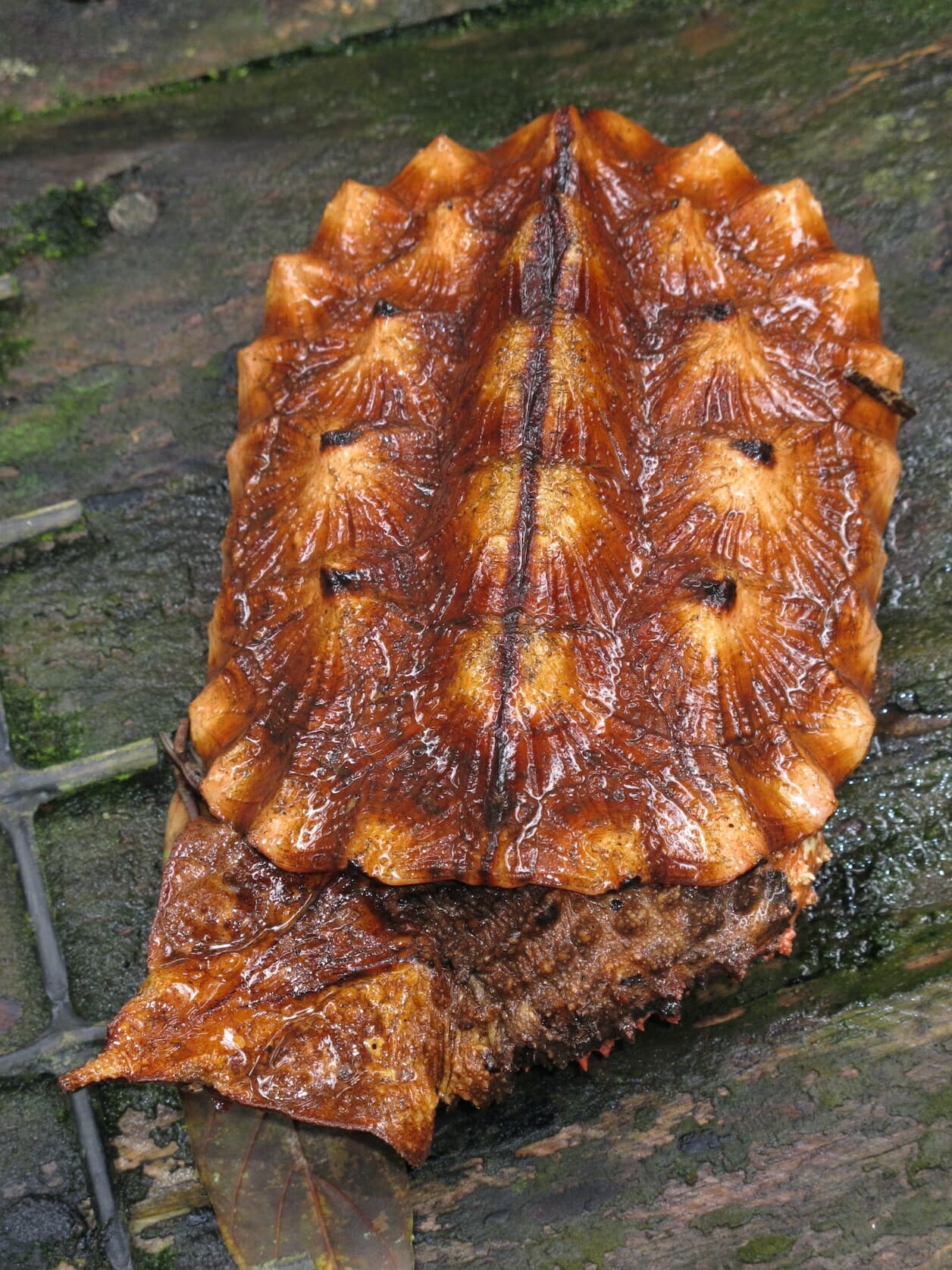
This is a large turtle, with females reaching over 50 cm in shell length and weighing up to 17 kg—males are noticeably smaller, rarely exceeding 42 cm. The shell is broad, low, and covered with three rows of knobby tubercles that form ridges running from front to back. In adults, the shell surface is extremely rough and sculptured, though this texture smooths somewhat with age. Shell color ranges from light to dark brown, often obscured by algae growth that helps the turtle blend into its surroundings.
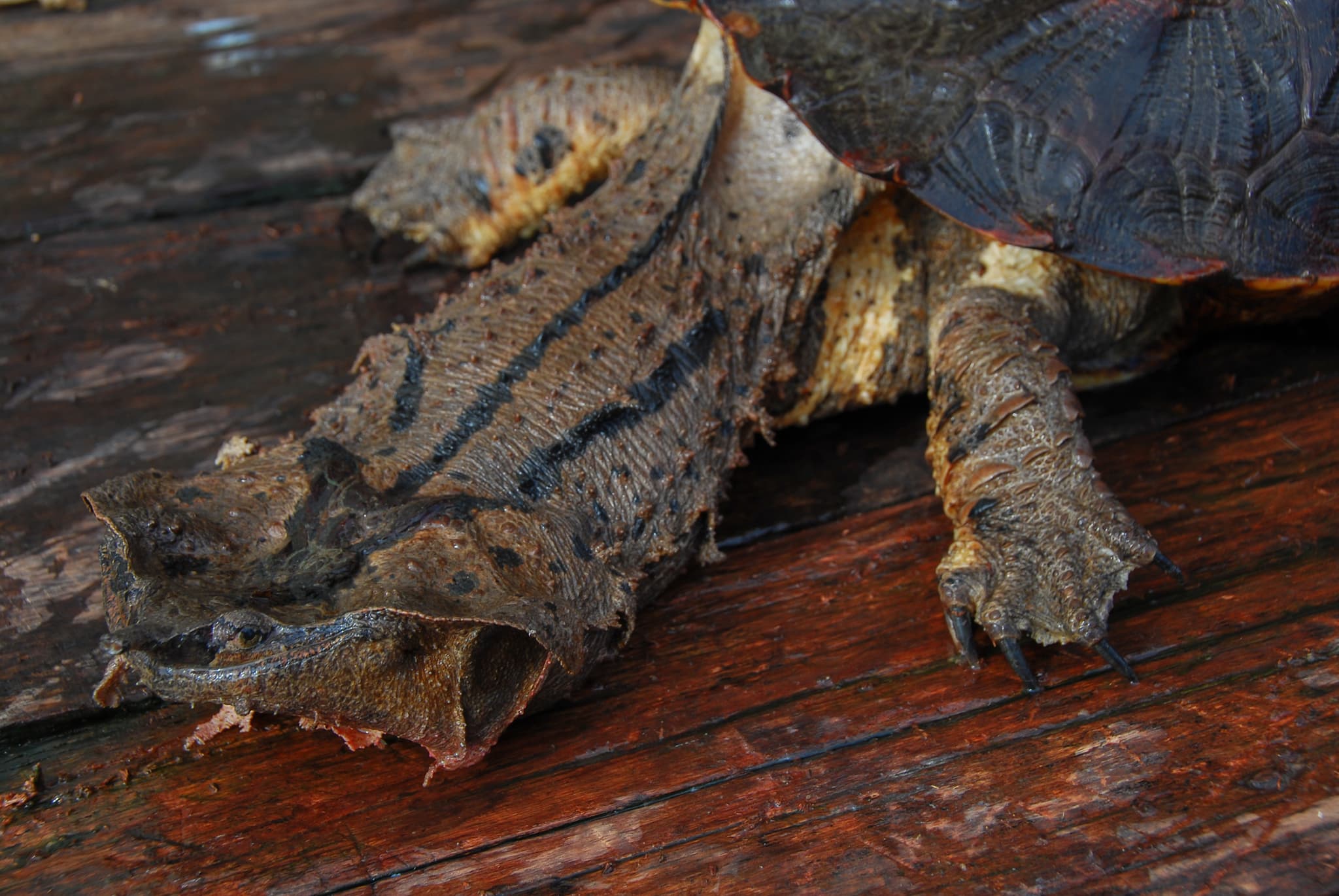
The head is what truly sets this species apart: extremely broad, triangular, and remarkably flat, with a long tubular snout that functions as a snorkel. The eyes are tiny and positioned far forward on the head. The mouth is enormously wide when viewed from the front but shorter in profile. Numerous fleshy skin flaps, fringes, and tassels adorn the head and neck—these aren't just decoration but are sensory organs that detect vibrations from approaching fish. Two small chin barbels sit beneath the lower jaw, and a row of four complex skin flaps crosses the throat.
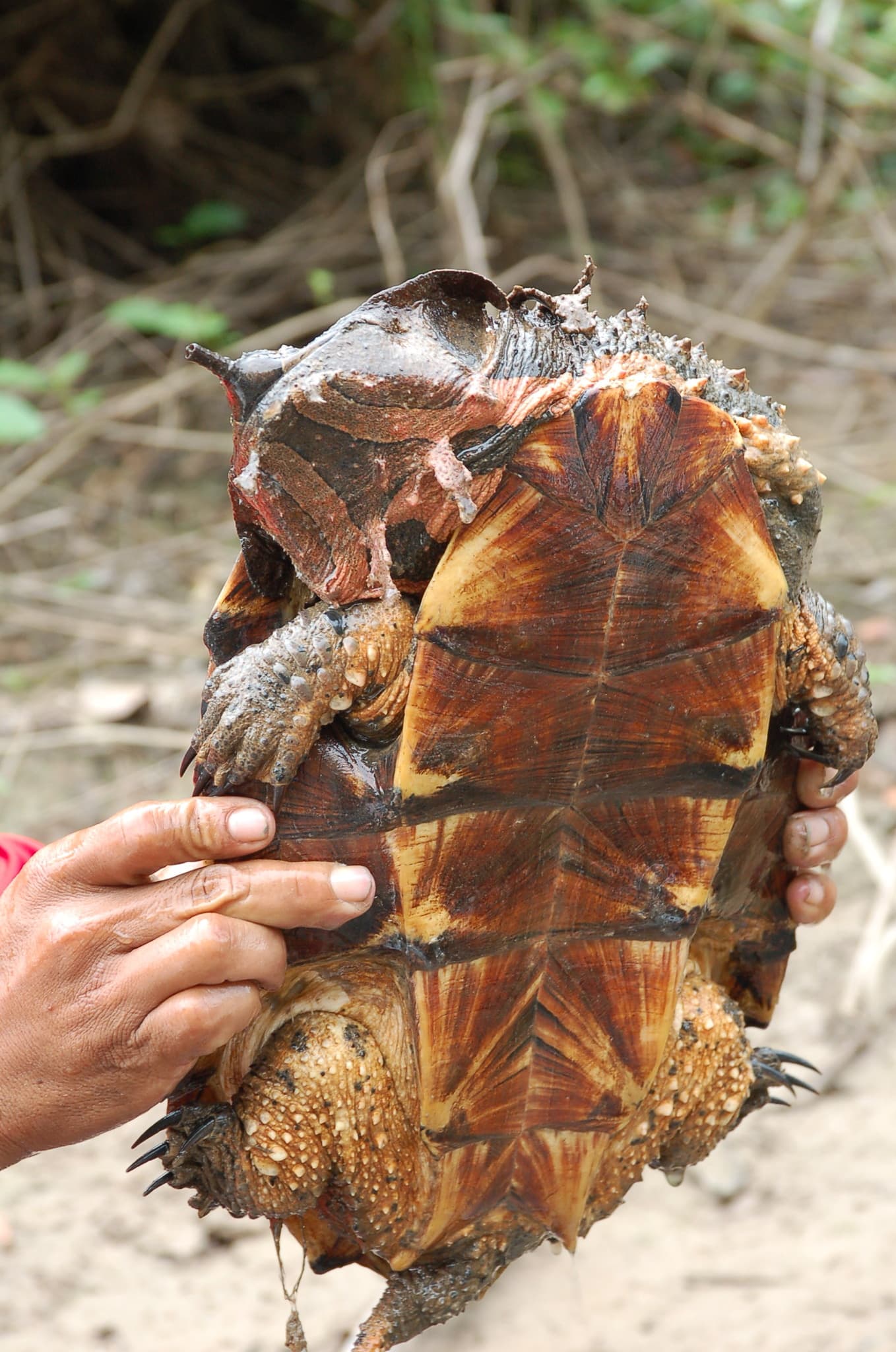
Amazon basin specimens have distinctive coloration: the underside of the neck sports a pair of bold black stripes running its length, and the plastron is typically heavily pigmented with dark markings or radiating patterns. The head is rich chestnut-brown on top with lighter coloring below. Hatchlings are more colorful than adults, often with reddish plastrons and distinct neck stripes.
Best estimate of natural adult weight based on turtles caught in the wild.
The female is generally larger than the male.
These are best estimates based on what has been observed and recorded.
Physical Features
Features shown are for Adult Males (reference). Look for the variant icon to see how a feature differs by sex or life stage.
Amazonian Mata Mata
Chelus fimbriata
Related Species | Quick Add
Distribution
Following the 2020 species split, Chelus fimbriata is now understood to be restricted to the Amazon Basin and the Mahury drainage of eastern French Guiana. It occurs across an enormous area of lowland tropical South America, inhabiting the main Amazon River and its countless tributaries.
The species is found in Brazil (throughout the Amazon basin states), Peru (eastern lowlands including Loreto and Ucayali), Ecuador (Amazonian provinces), Colombia (Amazonian departments including Amazonas, Caquetá, and Putumayo), Bolivia (northern lowlands), and French Guiana (eastern regions). It does not occur in the Orinoco basin, Essequibo drainage, or upper Rio Negro–Branco system—these areas are home to its sister species, Chelus orinocensis.
Habitat
The mata mata is thoroughly aquatic, inhabiting slow-moving, shallow waters throughout the Amazon basin. It favors still or sluggish waters: oxbow lakes, quiet inlets, slow-moving creeks, and the backwaters of larger rivers. Soft, muddy bottoms are strongly preferred, where the turtle can rest partially buried and virtually invisible.
This species thrives in murky, turbid waters where visibility is low—conditions that suit its ambush hunting style, which relies on detecting water vibrations rather than sight. It occurs in blackwater streams (stained dark by tannins), whitewater rivers (sediment-laden), and clearwater systems alike. Most records come from elevations below 200 meters above sea level.
The mata mata is a weak swimmer with limbs better adapted for walking along the bottom than for active swimming. It rarely ventures onto land except when females emerge to nest. When at rest, it positions itself so it can reach the surface to breathe by simply extending its long neck and snorkel-like snout, without having to swim.
Habitat Systems
Freshwater, Terrestrial
Habitat Types
Inland Wetlands
Predators
Little is documented about predation on mata matas. Giant river otters have been observed bringing adults ashore and occasionally killing them in Guyana (though this observation may have involved the sister species C. orinocensis). Eggs and hatchlings are presumably vulnerable to the typical suite of nest predators.
Interestingly, many adults show evidence of healed injuries—missing toes, feet, or occasionally even the proboscis or head skin flaps. In Venezuela, piranhas sharing the same habitats may be responsible for such mutilations, though this has not been confirmed.
Habitat Systems
Freshwater, Terrestrial
Habitat Types
Inland Wetlands
Behavior
Hibernation
The mata mata does not hibernate or aestivate. Living in tropical lowlands with relatively stable year-round temperatures and water availability, it remains active throughout the year. Water levels in its habitat fluctuate seasonally with wet and dry seasons, but the species simply moves with changing water levels rather than entering dormancy.
Diet
The mata mata is an extreme dietary specialist, feeding almost exclusively on live fish. Rather than pursuing prey, it employs a remarkable ambush strategy: lying perfectly still on the bottom, camouflaged among leaf litter and debris, it waits for fish to approach. The numerous skin flaps on its head are heavily innervated and detect even slight water movements caused by nearby fish.
When prey comes within range, the mata mata strikes with explosive speed. It rapidly opens its massive mouth while simultaneously expanding the huge hyoid apparatus in its throat, creating powerful suction that pulls water—and the unfortunate fish—into its gaping maw. The whole sequence happens so fast that the prey has virtually no chance to escape. Fish up to 20–25 cm in length have been recorded as prey. In captivity, mata matas will eventually accept dead fish, though they initially prefer live prey.
Nesting
Courtship behavior involves the male positioning himself in front of the female and repeatedly extending his head toward her while opening and closing his mouth. Movement of the lateral head flaps has been observed during these displays, along with exaggerated leg extension from the shell.
Nesting in the Amazon occurs from October through December. Unlike most Amazonian turtles that nest on open sandy beaches, mata matas select steep riverbanks of clayey sand or even excavate nests in decaying vegetation at forest edges. Females climb banks in a sideways fashion to negotiate steep grades. Nest sites are extremely difficult to locate, though indigenous peoples can find them with apparent ease.
Clutch sizes range from 12 to 28 eggs, with up to 32 recorded in captivity. The eggs are hard-shelled and nearly spherical, measuring 34–40 mm in diameter. Incubation is remarkably long—200 days or more in captivity, potentially quicker in the wild. Hatchlings emerge weighing 15–19 g with shell lengths around 49 mm.
Unique Traits and Qualities
The mata mata's most remarkable feature is its feeding mechanism—among the most specialized of any turtle. The combination of camouflage, sensory detection via innervated skin flaps, and explosive suction feeding makes it a supremely adapted ambush predator. When it strikes, the expansion of its massive hyoid apparatus creates such powerful suction that prey is essentially inhaled along with a rush of water.
The tubular snout is another remarkable adaptation, allowing the turtle to breathe while remaining almost completely submerged and motionless—only the tip of the snorkel breaks the surface. The tiny, anteriorly-placed eyes suggest that vision plays little role in prey detection; instead, the elaborate sensory flaps on the head and neck detect the vibrations of approaching fish, even in completely opaque water.
The mata mata has extremely poor swimming ability for an aquatic turtle, yet this apparent limitation suits its lifestyle perfectly. Rather than chasing prey, it simply waits—and its camouflage is so effective that it can remain virtually undetectable to both prey and predators.
Conservation
Status
Currently listed as Least Concern by the IUCN, though this assessment dates from 1996 and predates the 2020 species split—a reassessment considering the now-reduced range of C. fimbriata would be valuable. The species does not appear to be significantly threatened anywhere in its range, benefiting from its wide distribution, cryptic nature, and the fact that most local people find it unappetizing.
Unlike more palatable turtle species, the mata mata is seldom hunted for food. Its malodorous musk, bizarre appearance, and unusual distribution of meat (concentrated in the neck rather than the limbs) have earned it nicknames like "la fea" (the ugly one) in parts of its range. However, it is sought after in the international pet trade due to its unique appearance, with juveniles particularly prized by collectors.
The species receives nominal protection through comprehensive wildlife laws in Brazil and Colombia, and populations exist within several protected areas including Xingu in Brazil and Manu in Peru.
IUCN Red List Status: Least Concern
Environmental & Manmade Threats
The mata mata faces relatively few direct threats compared to other large South American freshwater turtles. Its unappetizing appearance and strong musk deter most subsistence hunting, and its cryptic nature makes it difficult to harvest in large numbers.
The primary concerns are habitat degradation and the pet trade. Amazon basin deforestation affects water quality and reduces prey fish populations. The species is popular among exotic pet enthusiasts due to its unique appearance, and while trade volumes are unknown, commercial shipments of both adults and juveniles occur. In some areas, ornamental fisheries personnel collect juvenile mata matas as bycatch in their nets.
Climate change and associated alterations to hydrology could affect the species long-term, though specific impacts are unstudied.
References
- Pritchard, P.C.H. 2008. Chelus fimbriata (Schneider 1783) – Matamata Turtle. In: Rhodin, A.G.J., Pritchard, P.C.H., van Dijk, P.P., Saumure, R.A., Buhlmann, K.A., and Iverson, J.B. (Eds.). Conservation Biology of Freshwater Turtles and Tortoises: A Compilation Project of the IUCN/SSC Tortoise and Freshwater Turtle Specialist Group. Chelonian Research Monographs No. 5, pp. 020.1–020.10, doi:10.3854/crm.5.020.fimbriata.v1.2008, http://www.iucn-tftsg.org/cbftt/.
- Vargas-Ramírez, M., Castaño-Mora, O.V., and Fritz, U. 2020. Genomic analyses reveal two species of the matamata (Testudines: Chelidae: Chelus spp.) and clarify their phylogeography. Molecular Phylogenetics and Evolution 148:106823. doi:10.1016/j.ympev.2020.106823.
- Cunha, F.A.G., Fagundes, C.K., Brito, E.S., Vogt, R.C., Maffei, F., Pezzuti, J., Félix-Silva, D., Rojas-Runjaic, F.J.M., Lasso, C.A., Morales-Betancourt, M.A., De Carvalho, V.T., Valsecchi Do Amaral, J., Balestra, R.A.M., Acácio, M., Malvasio, A., and Lustosa, A.P.G. 2021. Distribution of Chelus fimbriata and Chelus orinocensis (Testudines: Chelidae). Chelonian Conservation and Biology 20(1): 109–115. doi:10.2744/CCB-1398.1.
- GBIF Secretariat. 2024. Chelus fimbriata (Schneider, 1783). GBIF Backbone Taxonomy. https://www.gbif.org/species/2441927. Accessed 17 January 2026.
- Wikipedia contributors. 2025. Mata mata. Wikipedia, The Free Encyclopedia. https://en.wikipedia.org/wiki/Mata_mata. Accessed 17 January 2026.