

Big-Headed Pantanal Swamp Turtle
At a Glance
The Big-Headed Pantanal Swamp Turtle is a medium-sized side-necked turtle endemic to the wetlands and dry plains of central South America. True to its name, older females can develop remarkably large heads—up to 27% of their shell length—a trait called megacephaly that likely aids in crushing hard-shelled prey like snails. Found in the seasonally flooded Pantanal and the arid Chaco regions of Brazil, Bolivia, and Paraguay, this adaptable species has learned to exploit both natural brackish lagoons and artificial water sources created by cattle ranching. Despite facing habitat pressures, populations remain relatively stable for now, though increasing drought driven by climate change poses a growing concern.
Other Names People Call Me
Identification
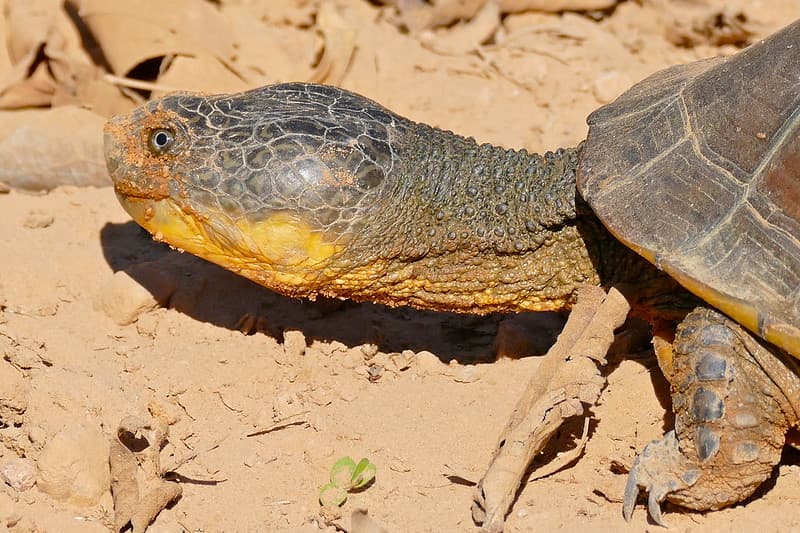
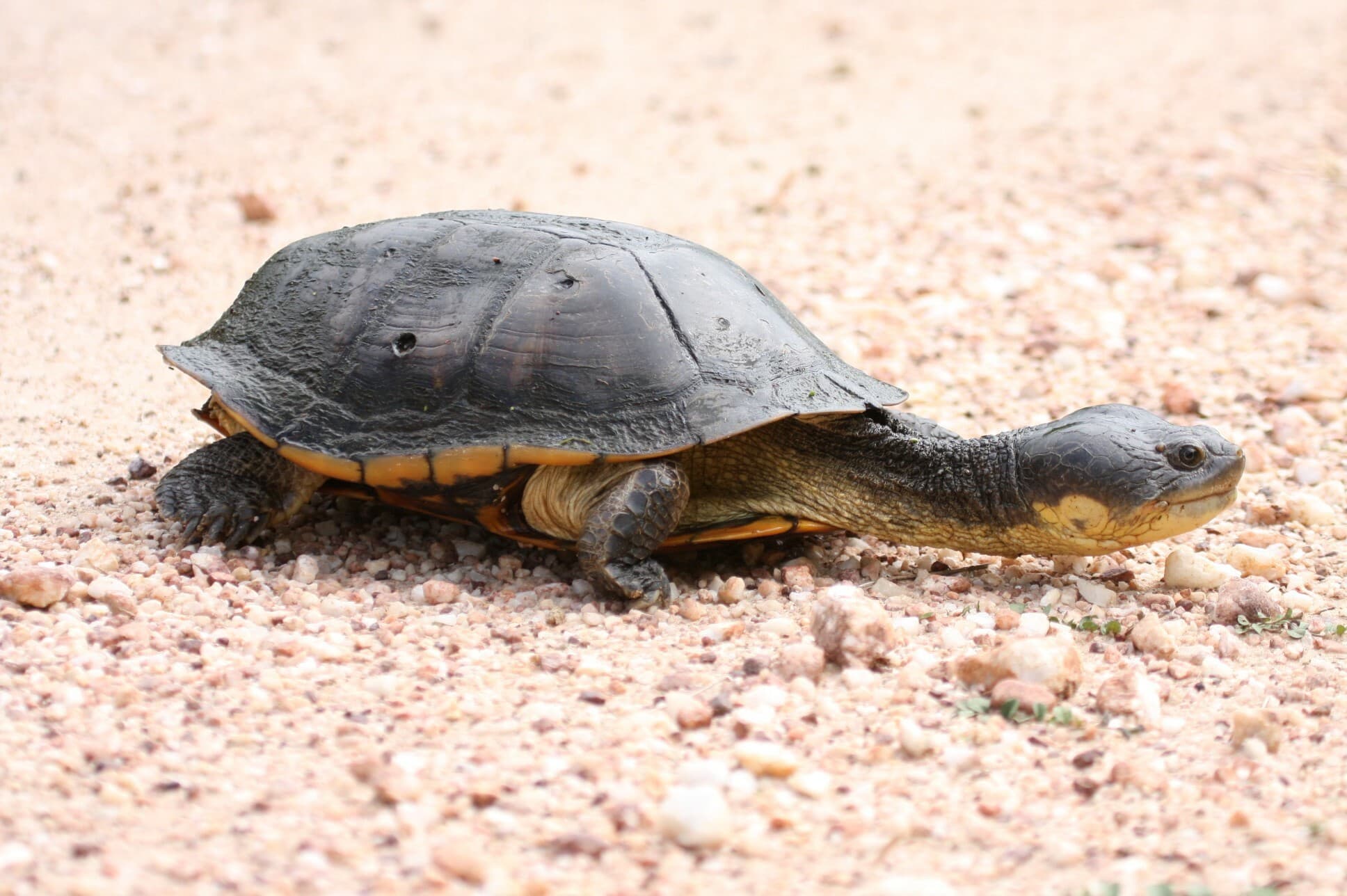
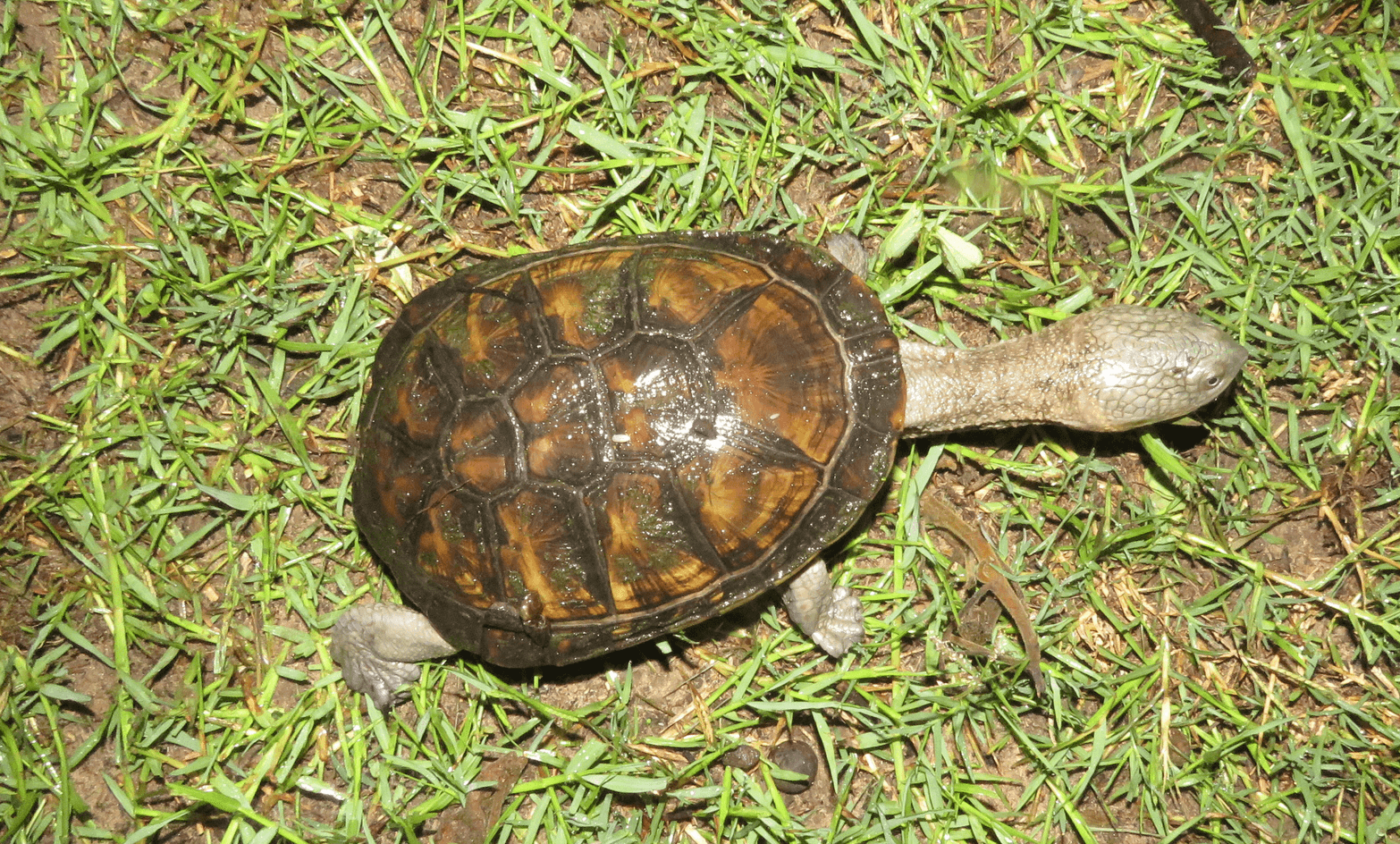
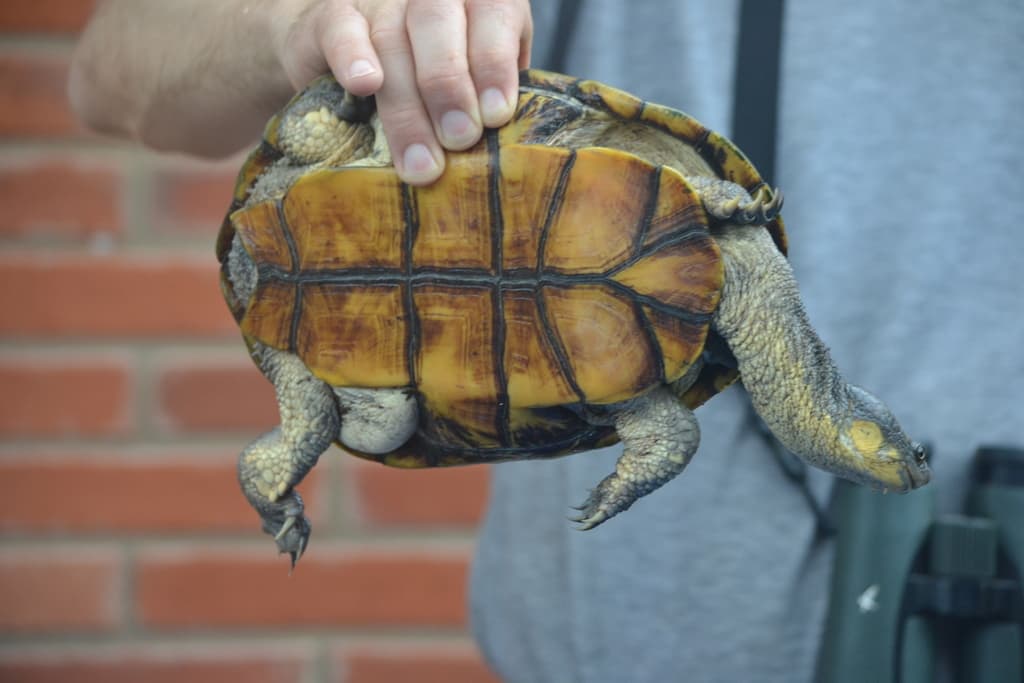
Females are the larger sex, reaching about 30 cm in shell length compared to around 24 cm for males. The shell is broadly oval and ranges from light to dark brown, with a yellow underside marked by dark lines along the seams—though these fade as the turtle ages.
The head is what really sets this species apart: broad, dark gray-brown on top, and yellow underneath. Look for two small barbels (fleshy whiskers) under the chin and a brownish-tan to silvery gray eye. The legs are gray above and yellowish below, sometimes with orange blotches.
Hatchlings are surprisingly colorful compared to adults. They sport bright yellow or orange patterns on their underside and a dark shell speckled with black spots. Each edge scute has a little yellow or orange triangle, and their head and throat are vivid yellow-orange with black markings.
Best estimate of natural adult weight based on turtles caught in the wild.
The female is generally larger than the male.
These are best estimates based on what has been observed and recorded.
Physical Features
Features shown are for Adult Males (reference). Look for the variant icon to see how a feature differs by sex or life stage.
Big-Headed Pantanal Swamp Turtle
Acanthochelys macrocephala
Related Species | Quick Add
Distribution
This turtle is found only in central South America, in parts of Brazil, Bolivia, and Paraguay. Its range spans two very different environments: the vast, seasonally flooded Pantanal wetland and the drier Chaco plains to the south and west. It sticks to lowland areas and doesn't venture into the higher, drier uplands surrounding the Pantanal.
Habitat
These turtles favor marshes, shallow bays, and brackish lagoons—salty pools known locally as "salinas" in Brazil. They seem to prefer large, shallow bodies of water, though they're not picky. What's remarkable is how well they've adapted to human-altered landscapes. In areas converted to cattle ranching, they've moved into roadside ditches, irrigation reservoirs, and artificial ponds built for livestock. This flexibility has helped them survive in changing environments, though it also ties their fate to water sources that can dry up during droughts.
Habitat Systems
Terrestrial, Freshwater
Habitat Types
Inland Wetlands
Predators
Not much is documented about what eats these turtles, but eggs and hatchlings are likely the most vulnerable—a common pattern for turtles. The months spent dormant underground during aestivation could also expose them to predators. Adults are reasonably well-protected by their shells, though that big head probably doesn't tuck away as neatly as it does in other species.
Habitat Systems
Terrestrial, Freshwater
Habitat Types
Inland Wetlands
Behavior
Hibernation
Instead of hibernating through cold winters, this species does the opposite—it aestivates, going dormant during the hot, dry season. In Paraguay's Chaco region, turtles leave the water as the rainy season ends in March or April, burrow into the ground, and stay dormant until the heavy rains return sometime between October and December. What's interesting is that this behavior seems hardwired in the Chaco population—they'll aestivate even if water is still available. Populations in southern Bolivia are more flexible, only going dormant when they need to. Either way, these turtles can handle remarkable temperature extremes, surviving conditions from below freezing to nearly 50°C.
Diet
The Big-Headed Pantanal Swamp Turtle is an opportunistic feeder, taking advantage of whatever prey is available in its wetland habitat. Its diet consists primarily of snails, tadpoles, small aquatic insects, small fish, and frogs. The species' characteristically robust, broad head and powerful jaws are well-suited for crushing hard-shelled mollusks, and researchers believe that the extreme megacephaly seen in older females may be an adaptation for exploiting this food source. Prey species in the Chaco region are often adapted to survive in both freshwater and brackish conditions, allowing the turtles to find food even in the saline lagoons they frequently inhabit.
Nesting
Mating starts with the male positioning himself in front of the female and bobbing his head up and down. Breeding typically happens around February, and females lay their eggs a few months later—timing varies by region, with Brazilian populations nesting in April–May. Females dig a nest about 10 cm deep using their back legs and deposit 4–9 nearly round eggs. The eggs need a cooling period during development, essentially a pause that mimics the natural dry season, before they'll hatch successfully. Baby turtles emerge around December or January, depending on location.
Unique Traits and Qualities
The oversized head is the headline feature—females can develop heads so massive they'd look almost comical if they weren't so well-suited for crushing snails. Compared to similar species, their heads are proportionally much larger. But equally impressive is their toughness. These turtles endure some of the most extreme temperature swings of any freshwater turtle, from below freezing to scorching heat, sometimes experiencing 20+ degree swings in a single day. They can also tolerate brackish water that would stress most freshwater species, allowing them to exploit salty lagoons others can't use.
Conservation
Status
Listed as Near Threatened, this species is holding steady for now but faces an uncertain future. The good news: populations remain fairly common, trade is minimal, and several protected areas across all three countries provide safe habitat. The concern: habitat loss continues in the Chaco region, and climate change is making droughts more frequent and severe—bad news for a turtle that depends on seasonal wetlands.
IUCN Red List Status: Near Threatened
Environmental & Manmade Threats
Habitat loss is the main concern, particularly in the Chaco where cattle ranching has already converted a significant portion of the landscape. The Pantanal is in better shape but still faces pressure. The trickier problem is climate change. These turtles have cleverly adapted to use artificial water sources like cattle ponds, but those dry up during droughts—and droughts are getting worse. A turtle that depends on seasonal wetlands and temporary pools is in a tough spot when the rains become less reliable.