

Black Spine-Necked Swamp Turtle
At a Glance
The Black Spine-Necked Swamp Turtle is a medium-sized freshwater turtle with a striking appearance—adults are almost entirely black, while hatchlings sport vivid red or orange spots that fade with age. Found in southeastern Brazil, Uruguay, and a small corner of northeastern Argentina, this adaptable turtle inhabits everything from pristine marshes to rice paddies and urban parks. Recently upgraded to Vulnerable on the IUCN Red List, it faces mounting pressure from habitat loss as more than 60% of its range has already been converted to agricultural and urban landscapes.
Other Names People Call Me
Identification
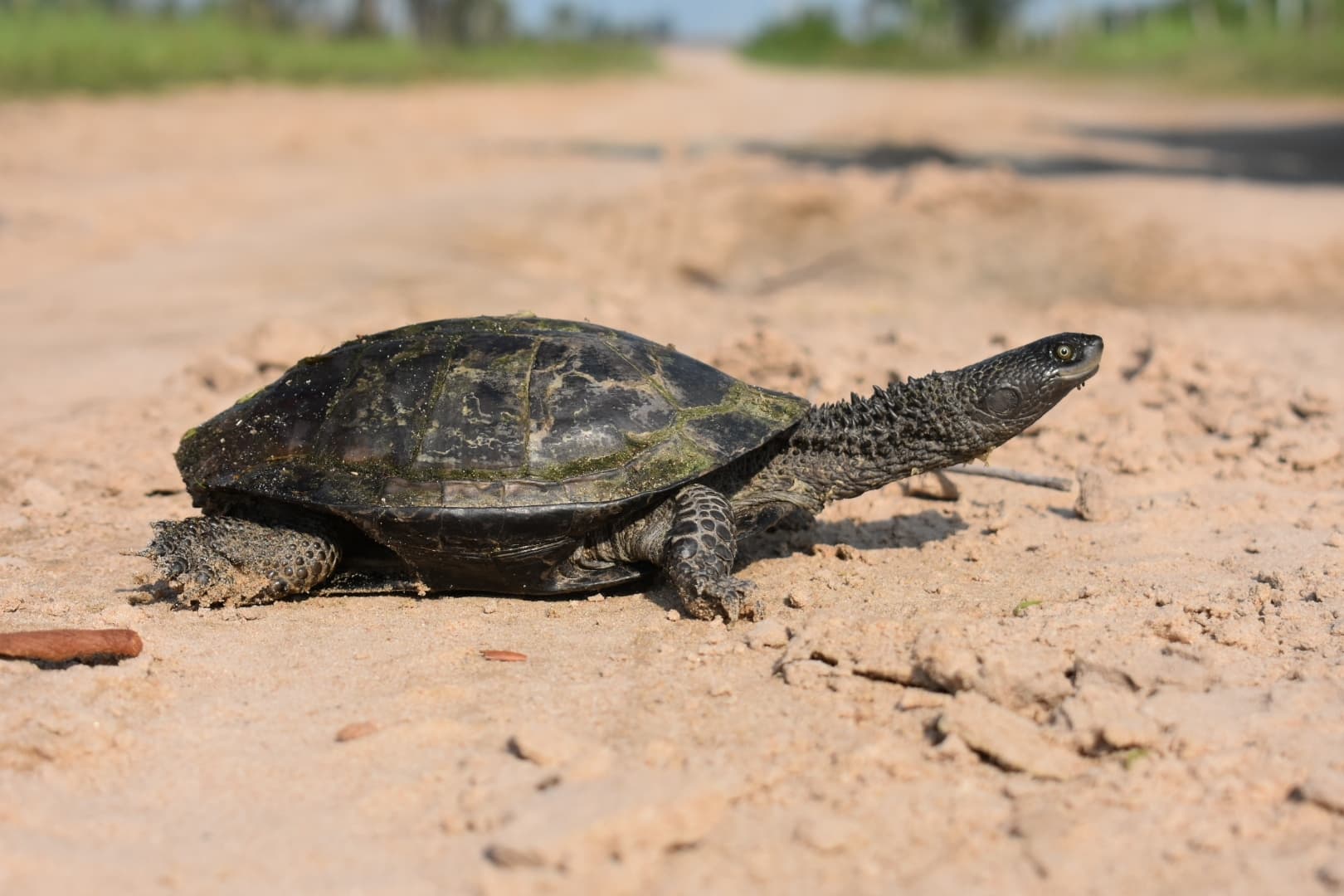
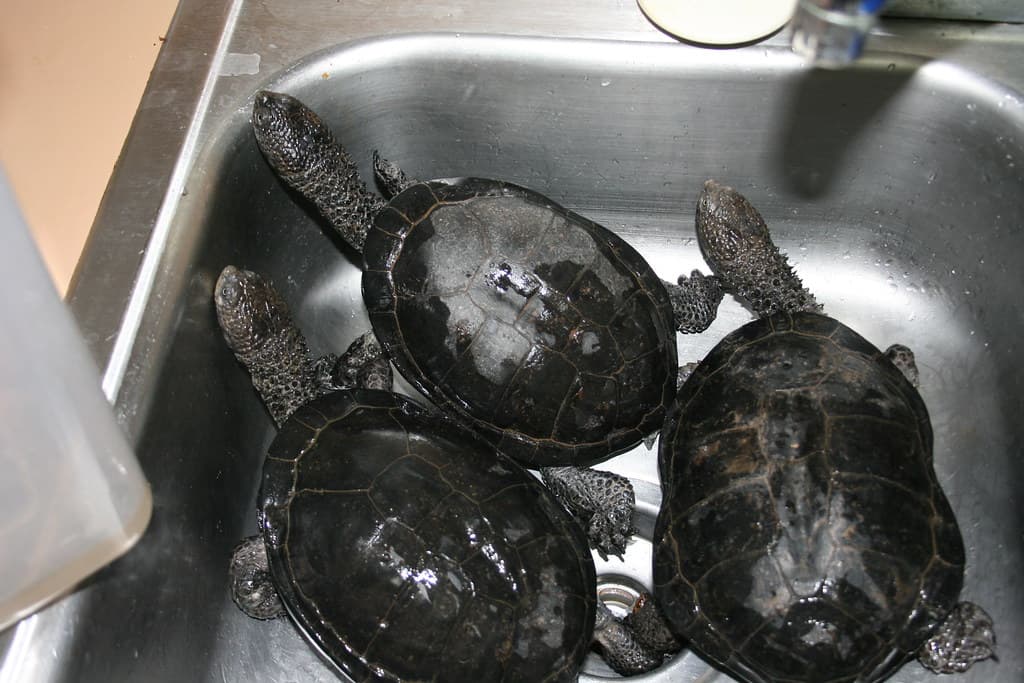
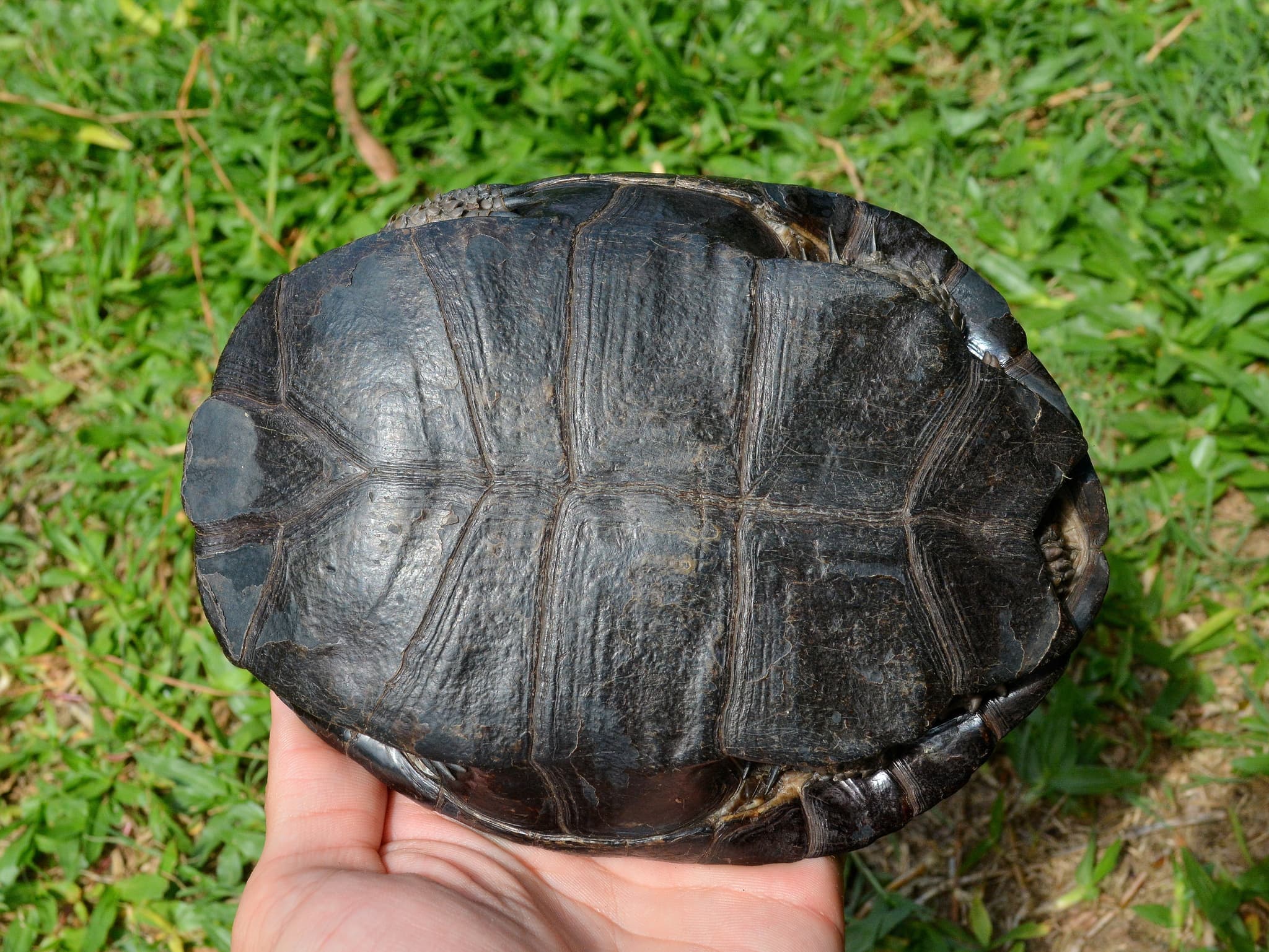
Females are the larger sex, reaching up to 20 cm in shell length compared to about 18 cm for males. The shell is slightly domed (more so in females), elliptical in shape, and broader toward the rear. Adults are almost uniformly black or dark reddish-brown above, with a completely black or dark brownish-black underside.
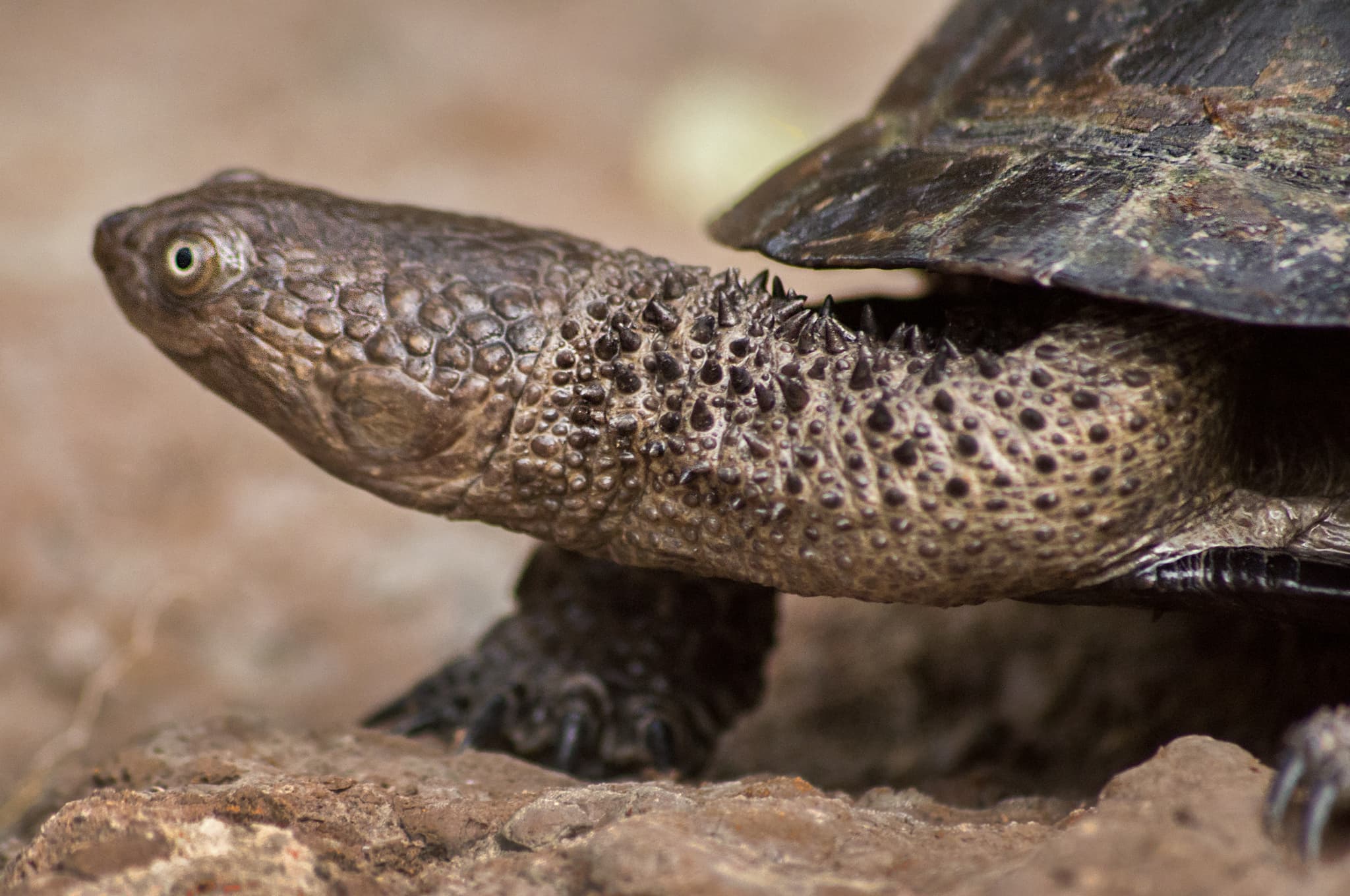
The head is flat, elongated, and oval, covered with irregularly grooved skin. Look for two short barbels (fleshy whiskers) under the chin and bright yellow eyes positioned on the sides of the head. The neck is distinctive—its upper surface and sides are studded with prominent spiny tubercles among sparse granular scales, giving this turtle its common name. The legs are short but sturdy, with fully webbed feet and five claws on the front feet, four on the back.
Hatchlings are strikingly different from adults. They're dark black with vivid red or deep orange spots decorating the border of each marginal scute around the shell's edge. The underside displays large orange or red blotches on a black background—colors that gradually fade as the turtle matures.
Best estimate of natural adult weight based on turtles caught in the wild.
It is unknown whether there is a significant size difference between the sexes.
These are best estimates based on what has been observed and recorded.
Physical Features
Features shown are for Adult Males (reference). Look for the variant icon to see how a feature differs by sex or life stage.
Black Spine-Necked Swamp Turtle
Acanthochelys spixii
Related Species | Quick Add
Distribution
This turtle is found across a broad swath of southeastern South America. In Brazil, it occurs in eight states spanning from Bahia in the northeast through the central highlands (Distrito Federal, Goiás, Minas Gerais) to the southern states of São Paulo, Paraná, Santa Catarina, and Rio Grande do Sul. The range extends into Uruguay, where it's found in seven departments primarily in the eastern and northern parts of the country. In Argentina, it's restricted to Corrientes Province in the northeast.
The species' estimated extent of occurrence is approximately 1.65 million square kilometers when marine areas are excluded. Historical records from Chaco and Formosa Provinces in Argentina likely represent misidentified specimens of the closely related Chaco Side-necked Turtle.
Habitat
These turtles favor diverse wetland habitats with slow-moving or standing shallow water—swamps, ponds, and marshes, often thick with submerged vegetation. In Uruguay, they're found in coastal zones, inhabiting both temporary and permanent ponds with clear water and lime-sandy bottoms, often with sparse vegetation.
What's remarkable is their adaptability. In Brazil, they thrive at the interface between open savanna (Cerrado) and dense Atlantic Forest, but they've also colonized human-altered landscapes including residential areas, urban parks, and rice paddies. This flexibility has helped populations persist in changing environments, though it also exposes them to new threats like agricultural chemicals. The species ranges from sea level up to about 1,080 meters elevation in Brazil's Serra da Canastra National Park.
Habitat Systems
Terrestrial, Freshwater
Habitat Types
Inland Wetlands, Artificial Waters, Coastal Waters
Predators
Little is documented about what preys on these turtles. As with most turtle species, eggs and hatchlings are likely the most vulnerable life stages. The months spent dormant underground during estivation could also expose buried turtles to predators. Adults benefit from the protection of their shells, and their ability to withdraw into burrows when ponds dry up probably offers additional safety. Leeches of the family Hirudidae parasitize this species, concentrating in the protected skin folds near the shell.
Habitat Systems
Terrestrial, Freshwater
Habitat Types
Inland Wetlands, Artificial Waters, Coastal Waters
Behavior
Hibernation
Rather than hibernating through cold winters, this species estivates—going dormant during dry periods when their wetland habitats shrink or disappear. When ponds begin drying up, individuals burrow into the ground, sometimes reaching depths of about 50 cm below the surface. They remain dormant underground until conditions improve, presumably emerging when rains return and refill their aquatic habitats.
Activity, movement, and habitat use all increase with rising air and water temperatures. The species is primarily nocturnal, though daytime activity has been observed, particularly during courtship and nesting.
Diet
These turtles are opportunistic feeders with a generalist diet. Insects make up the bulk of their meals, particularly aquatic insects which comprise more than half of their prey items. They also eat tadpoles, small fish, snails, and spiders. In captivity, they readily accept beef, fish, shrimp, and small frogs. Studies have found high dietary overlap between males and females, suggesting both sexes exploit similar food resources.
Nesting
Reproductive timing varies across the range. In Brazil, the nesting season runs from February to May, while in Uruguay, breeding has been suggested to occur in August, with hatchlings commonly appearing from September through February. Observations in Brasília National Park recorded mating events between November and December during the rainy season.
Clutch sizes range from 4 to 8 eggs, with an average of about 5. The eggs are nearly spherical, measuring roughly 25–27 mm in length. Females dig shallow nests about 4 cm deep. Here's a remarkable quirk: this species may have the longest incubation period of any South American side-necked turtle—potentially 587 to 615 days, including a diapause (developmental pause) period. This extended incubation appears to be an adaptation to the unpredictable dry and rainy seasons of their South American habitat. Hatchlings emerge at 31–32 mm shell length and weigh approximately 5 grams.
Unique Traits and Qualities
The spiny tubercles studding the neck are the namesake feature—prominent cornified cones that give this turtle a distinctively rough-textured appearance unlike most other freshwater turtles. These spines, combined with the species' predominantly black coloration, make adults unmistakable within their range.
The dramatic color change from hatchling to adult is equally striking. Young turtles with their vivid red and orange markings look almost like different species compared to the uniformly dark adults. This transformation happens gradually over the first months of life.
The species' exceptional adaptability is another defining trait. Few turtles thrive equally well in pristine wetlands and urban parks, rice paddies, and roadside ditches. This flexibility has helped populations persist even as natural habitats disappear—though it also exposes them to threats like agricultural chemicals and road traffic.
Conservation
Status
Listed as Vulnerable on the IUCN Red List due to ongoing habitat loss, this species faces an uncertain future despite its relatively wide distribution. The numbers tell a concerning story: as of 2021, over 62% of its range has been converted from natural to human-dominated landscapes. Brazil, which encompasses over 90% of the species' distribution, has seen 8.9% of habitat converted just in the last 37 years, leaving only about 35% of its Brazilian range in natural condition. Argentina offers more hope with over 90% of habitat intact, while Uruguay falls in between at about 62%.
The species is legally protected in all three countries and occurs in numerous protected areas, including seven national parks in Uruguay and over 20 protected areas in Brazil. Captive breeding programs exist in both countries. However, illegal pet trade—increasingly conducted through social media—remains a concern, and enforcement of existing protections needs strengthening.
IUCN Red List Status: Vulnerable
Environmental & Manmade Threats
Habitat loss is the primary threat. Urbanization and agricultural conversion have transformed the majority of this turtle's range, with Brazil—home to over 90% of the species' distribution—showing the most severe habitat degradation. Only about 35% of Brazilian habitat remains in natural condition.
In Uruguay, urban development, agricultural conversion, and road mortality all take their toll. The illegal pet trade has increased with the rise of social media, though legal breeding programs exist. In southern Brazil, large-scale rice cultivation encroaches on important mating and nesting areas around coastal lagoons. Other threats include mineral extraction, periodic forest fires, and hydroelectric development.
Perhaps most concerning, recent research has documented chromosomal damage and other cellular abnormalities in turtles living in agricultural areas of São Paulo State, indicating chronic exposure to harmful agrochemicals. Despite the species' demonstrated resilience and adaptability, these cumulative pressures pose a credible risk to its long-term survival.
References
- Marques, T.S., Estrades, A., Fallabrino, A., Horta, G.d.F., Portelinha, T.C.G., Yves, A., Valadão, R.M., Cabrera, M.R., Florencia David, M., and Miorando, P.S. 2025. Acanthochelys spixii (Duméril and Bibron 1835) – Black Spiny-necked Turtle, Spix's Sideneck Turtle, Tortuga de Canaleta, Cágado do Cerrado. In: Rhodin, A.G.J., Iverson, J.B., van Dijk, P.P., Stanford, C.B., Goode, E.V., Buhlmann, K.A., and Mittermeier, R.A. (Eds.). Conservation Biology of Freshwater Turtles and Tortoises: A Compilation Project of the IUCN/SSC Tortoise and Freshwater Turtle Specialist Group. Chelonian Research Monographs 5(19):131.1–10. doi:10.3854/crm.5.131.spixii.v1.2025, http://www.iucn-tftsg.org/cbftt/.
- Marques, T.S., Estrades, A., Fallabrino, A., Horta, G.d.F., Portelinha, T.C.G., Yves, A., Valadão, R.M., Cabrera, M.R., Florencia David, M., and Miorando, P.S. (in press). Acanthochelys spixii. The IUCN Red List of Threatened Species.