

Brazilian Radiolated Swamp Turtle
At a Glance
The Brazilian Radiolated Swamp Turtle is a shy, medium-sized side-neck found only in Brazil's Atlantic Forest region. Named for the radiating striations on its shell, this polymorphic species displays remarkable color variation—from dark olive to black carapaces—and remains one of the least-studied turtles in its genus. Listed as Near Threatened based on a decades-old assessment, its true conservation status in the face of ongoing Atlantic Forest destruction remains unclear.
This species profile contains limited information and may be incomplete. Some sections may be missing data or require further research.
Identification
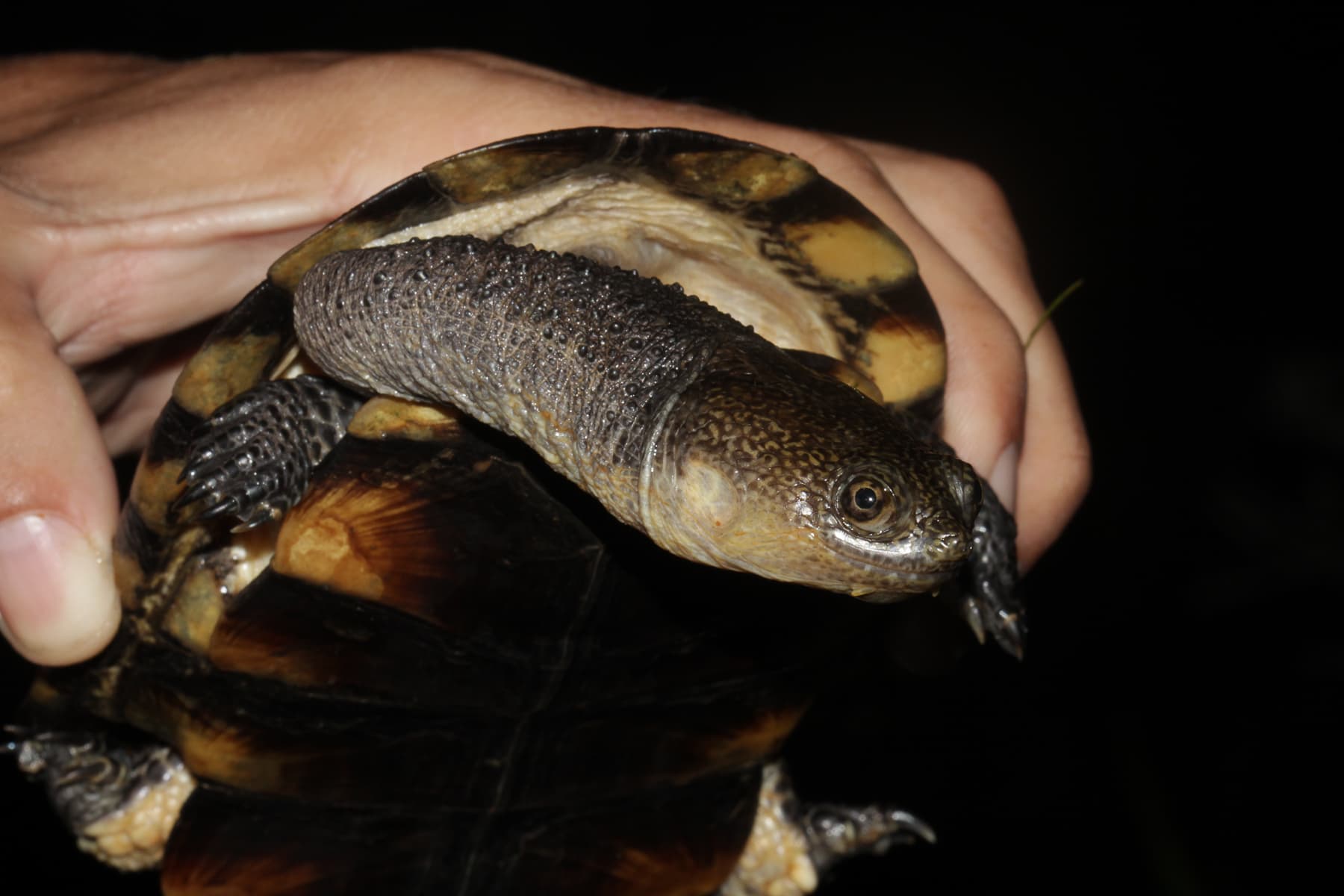
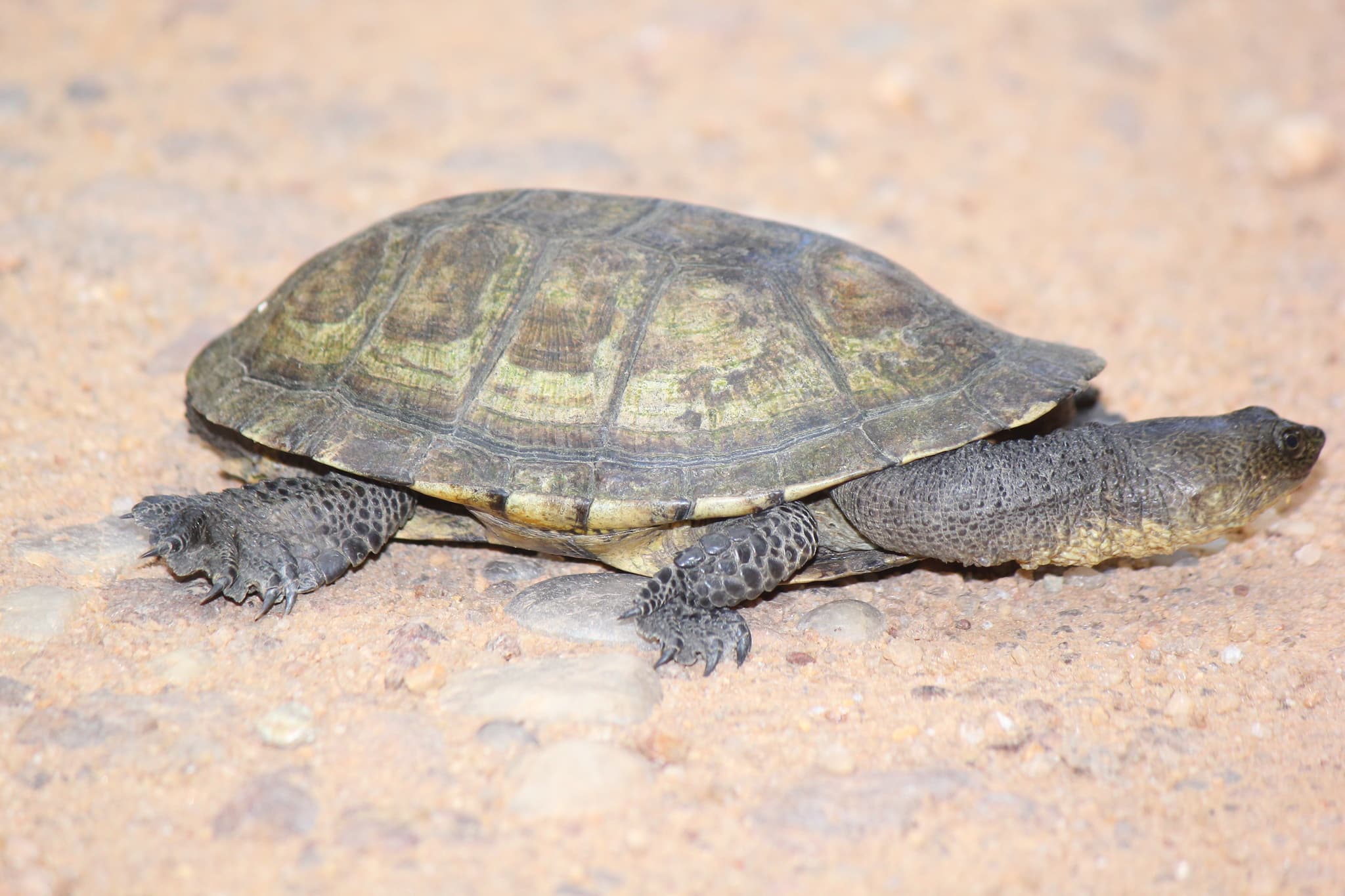
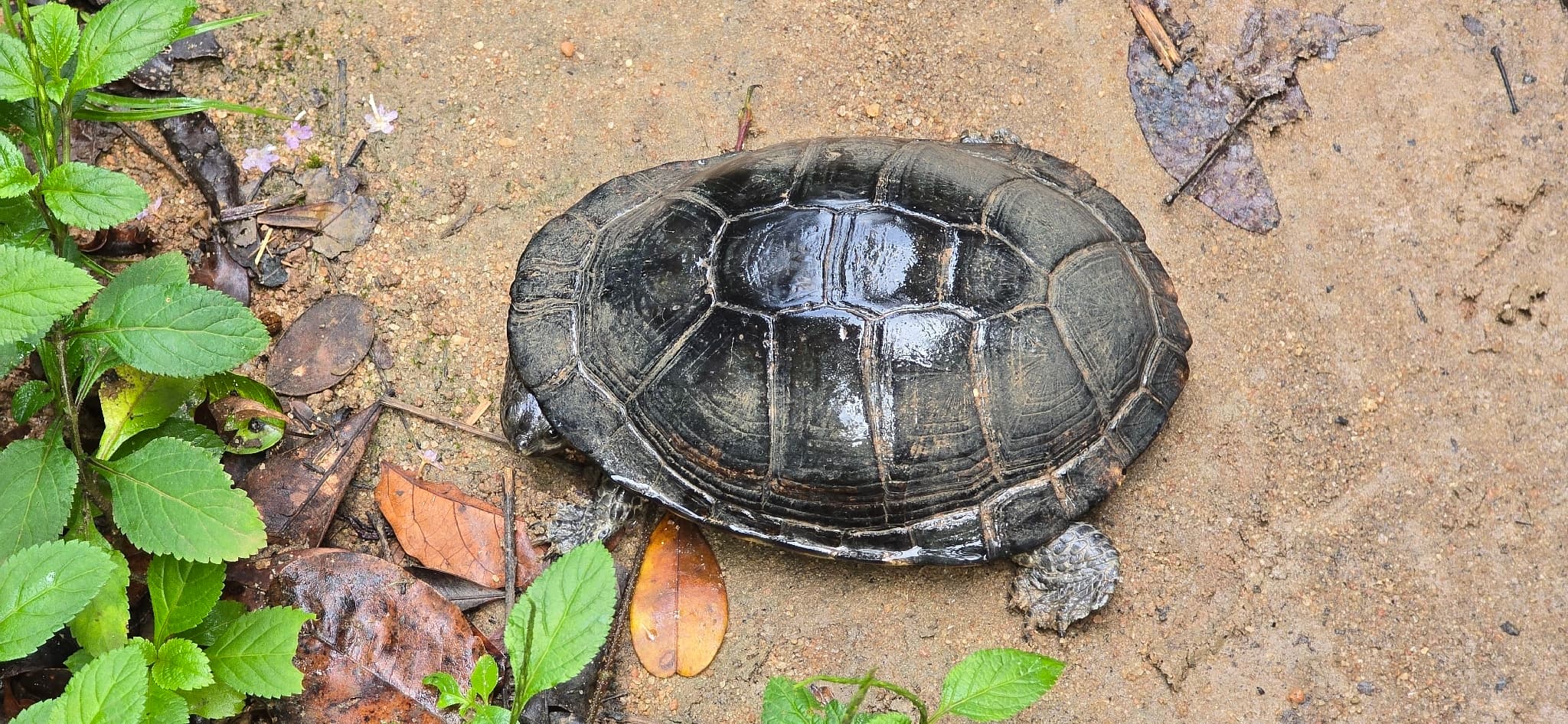
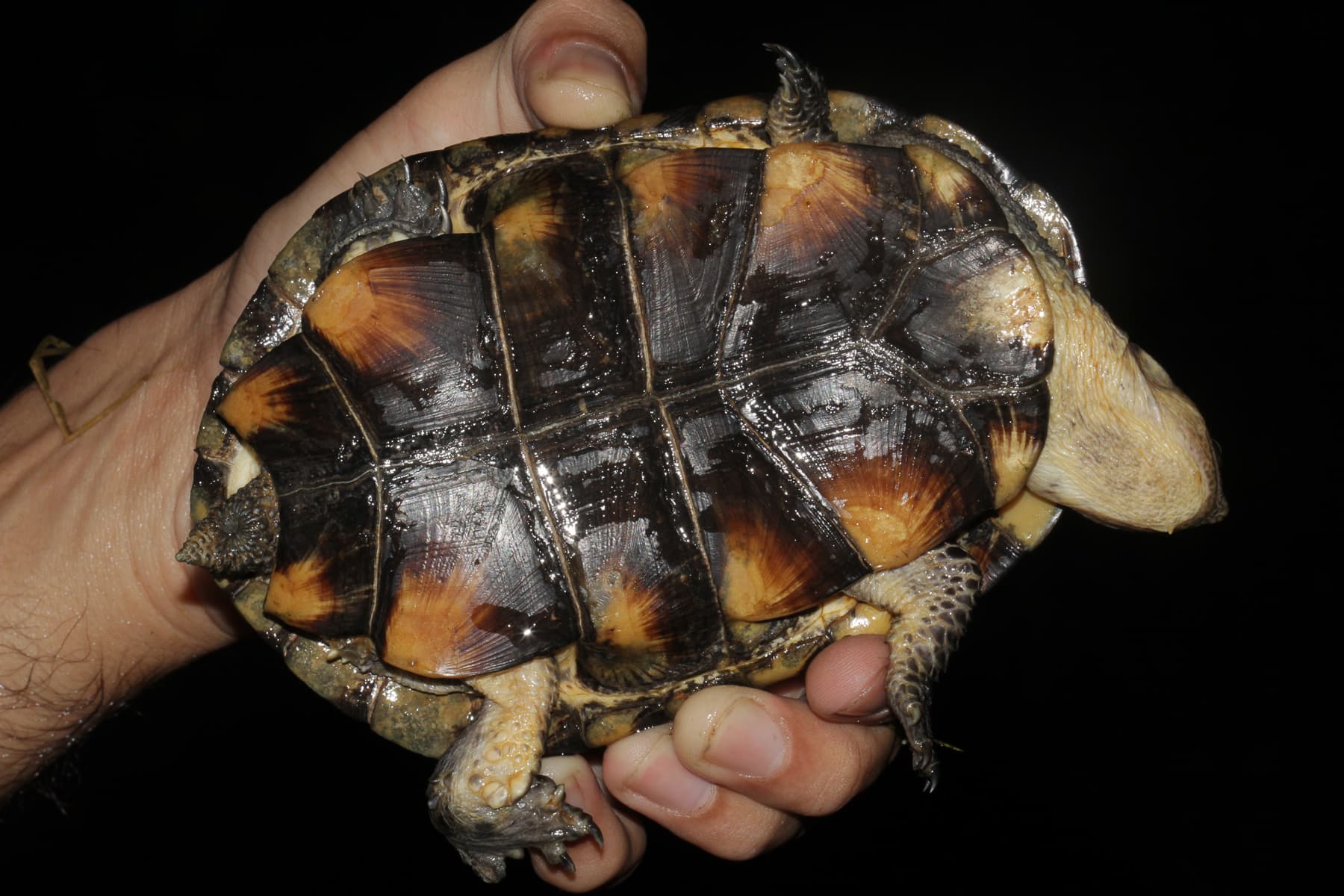
A medium-sized side-neck reaching about 20 cm in shell length, this turtle's most distinctive feature is the pattern of fine lines radiating outward from the back edge of each shell scute—the source of its "radiolated" name. The flattened, elliptical shell shows a shallow groove running between the second and fourth vertebral scutes. Shell color is highly variable: some individuals are uniformly dark olive, gray, or black, while others display different patterns. The yellow plastron may show a large central dark blotch, scattered mottlings, or dark borders along the scute seams.
The head is olive to grayish-brown on top and yellow on the sides and underneath. Two small yellow barbels hang from the chin, and the iris is distinctively white. The neck is bicolored—olive to brown above, yellow below—and covered with numerous short, rounded tubercles on top. A key identification feature is the pretibial flap of large scales on each hindleg, which distinguishes this species from similar-looking Phrynops turtles.
Males have concave plastrons and longer, thicker tails with the vent extending beyond the shell margin. Females have flat plastrons and shorter tails tucked beneath the shell.
Hatchlings are more colorful than adults. They sport grayish-brown shells marked with a wedge-shaped yellow spot on each marginal scute. The plastron is bright yellow with a large dark central blotch that spreads outward along the seams, and the yellow bridge shows two dark spots. The throat and neck undersides are yellow to cream with bold dark blotches.
Best estimate of natural adult weight based on turtles caught in the wild.
It is unknown whether there is a significant size difference between the sexes.
These are best estimates based on what has been observed and recorded.
Physical Features
Features shown are for Adult Males (reference). Look for the variant icon to see how a feature differs by sex or life stage.
Brazilian Radiolated Swamp Turtle
Acanthochelys radiolata
Related Species | Quick Add
Distribution
Endemic to Brazil, this species occurs along the country's Atlantic coast in a relatively narrow strip. Its range extends from the northeastern state of Alagoas southward through Sergipe, Bahia, Espírito Santo, and Rio de Janeiro, reaching as far south as São Paulo. Inland populations occur in Minas Gerais and Mato Grosso. The species is restricted to the Atlantic Forest domain, one of the world's most threatened biomes.
Habitat
This turtle favors slow-moving waters with soft bottoms and abundant aquatic vegetation. It's been documented in coastal lakes, bogs, puddles, marshes, and swamps throughout the Atlantic Forest biome. Though traditionally described as preferring still (lentic) waters, recent research has found it occupying rivers with varying flow rates, expanding our understanding of its habitat flexibility. During mating, individuals have been observed moving across steep, uneven terrain, and nesting occurs in areas with dense plant cover near tree roots.
Habitat Systems
Terrestrial, Freshwater
Habitat Types
Inland Wetlands
Predators
No specific predators have been documented for this species. Like most freshwater turtles, eggs and hatchlings are presumably the most vulnerable life stages, likely falling prey to various mammals, birds, and snakes. Adults benefit from shell protection but their relatively small size may leave them vulnerable to larger predators. The species' shy, retiring behavior may be an adaptation to predation pressure.
Habitat Systems
Terrestrial, Freshwater
Habitat Types
Inland Wetlands
Behavior
Hibernation
No hibernation or aestivation behavior has been documented for this species. Given its occurrence in tropical and subtropical regions of Brazil's Atlantic coast, where temperatures remain relatively warm year-round, extended dormancy periods are unlikely. The species may reduce activity during cooler or drier periods, but specific behavioral adaptations to seasonal changes remain unstudied.
Diet
This species appears to be primarily carnivorous, feeding on fish, amphibians, aquatic insects, snails, and worms. In captivity, it readily accepts various animal foods but has also been observed eating plant matter. Its diet in the wild likely consists of whatever small aquatic prey it can catch in the slow-moving, vegetated waters it inhabits.
Nesting
Based on captive breeding observations, mating occurs between November and March, following a consistent pattern of approach, pursuit, and copulation. Females lay small clutches of just two to four eggs in nests dug near tree roots and covered with leaves. Specific details about incubation period, egg dimensions, and hatchling emergence timing in the wild remain unknown due to limited field research on this species.
Unique Traits and Qualities
The radiating striations on the shell scutes give this turtle both its common and scientific names—a pattern that's particularly visible on well-preserved museum specimens. What makes the species especially interesting to researchers is its remarkable polymorphism: shell color varies dramatically across its range, with two distinct carapace color patterns and three plastron patterns documented. This variability initially led some scientists to believe they were looking at multiple species or subspecies.
Another distinctive feature is the pretibial flap of large scales on each hindleg—a characteristic shared with other Acanthochelys species but never found in the similar-looking Phrynops turtles. This detail provides a reliable way to distinguish hatchlings, which otherwise can appear confusingly similar. The species is notably shy in captivity, spending much of its time hiding.
Conservation
Status
Listed as Near Threatened by IUCN based on a 1996 assessment—well before modern criteria were established—this species badly needs reassessment. It was not included in Brazil's national red list as of 2015, creating uncertainty about its actual status. The Atlantic Forest, where it lives, has lost the vast majority of its original cover, making habitat loss the presumed primary threat. Some populations occur within protected areas, including Brazil's Serra do Conduru State Park and the Itacaré-Serra Grande Environmental Protection Area in southern Bahia, which may provide some refuge.
IUCN Red List Status: Data Deficient
Environmental & Manmade Threats
Habitat destruction is the most significant presumed threat. The Atlantic Forest, where this species lives exclusively, has been reduced to roughly 12% of its original extent—making it one of the most threatened biomes on Earth. Urbanization, agriculture, and deforestation continue to fragment and degrade remaining habitat. Rivers and streams in the region face ongoing pressure from human activities including pollution and water extraction. The lack of recent population assessments makes it difficult to quantify actual impacts, but any species restricted to such a threatened ecosystem faces an uncertain future.
References
- Schiavetti, A., Batista, T.S., Ferreira, E.S., and Solé, M. 2021. Brazilian Radiolated Swamp Turtle Acanthochelys radiolata (Mikan, 1820) in rivers of the Atlantic Forest of southern Bahia, Brazil. Herpetology Notes 14: 609–612.
- Tortoise & Freshwater Turtle Specialist Group. 2016 [errata version of 1996 assessment]. Acanthochelys radiolata. The IUCN Red List of Threatened Species 1996: e.T78A97260100. https://www.iucnredlist.org/species/78/97260100. Accessed 15 January 2025.
- Ernst, C.H. and Barbour, R.W. 1989. Turtles of the World. Smithsonian Institution Press, Washington D.C.
- GBIF Secretariat. 2025. Acanthochelys radiolata (Mikan, 1820). GBIF Backbone Taxonomy. https://www.gbif.org/species/2441986. Accessed 15 January 2025.
- Uetz, P., Freed, P., Aguilar, R., Reyes, F., Kudera, J. & Hošek, J. (eds.). 2025. Acanthochelys radiolata. The Reptile Database. https://reptile-database.reptarium.cz/species?genus=Acanthochelys&species=radiolata. Accessed 15 January 2025.
- iNaturalist. 2025. Acanthochelys radiolata. https://www.inaturalist.org/taxa/39609-Acanthochelys-radiolata. Accessed 15 January 2025.
- Garbin, R.C., Karlguth, D.T., Fernandes, D.S. & Pinto, R.R. 2016. Morphological variation in the Brazilian Radiated Swamp Turtle Acanthochelys radiolata (Mikan, 1820) (Testudines: Chelidae). Zootaxa 4105(1): 45–64. doi:10.11646/zootaxa.4105.1.2
- Mocelin, M.A., Fernandes, R., Porto, M. & Fernandes, D.S. 2008. Reproductive Biology and Notes on Natural History of the Side-necked Turtle Acanthochelys radiolata (Mikan, 1820) in Captivity (Testudines: Chelidae). South American Journal of Herpetology 3(3): 223–228.