

Chaco Side-Necked Turtle
At a Glance
The Chaco Side-Necked Turtle is one of South America's most elusive freshwater turtles, spending up to eight months of the year buried underground waiting for rain. Endemic to the dry shrub forests of the Gran Chaco in Argentina, Paraguay, and Bolivia, this small turtle exists in tiny, scattered populations that emerge only during the brief summer rainy season. Listed as Endangered, it faces severe pressure from agricultural expansion that's rapidly destroying its specialized habitat of seasonal marshes and clay-bottomed lowlands.
Other Names People Call Me
Identification
This is a small to medium-sized turtle, with adults typically reaching 13–16 cm in shell length and weighing around 400 grams. The maximum recorded sizes are 18 cm for males and 17.5 cm for females, though sexual size differences are minimal and inconsistent between populations.
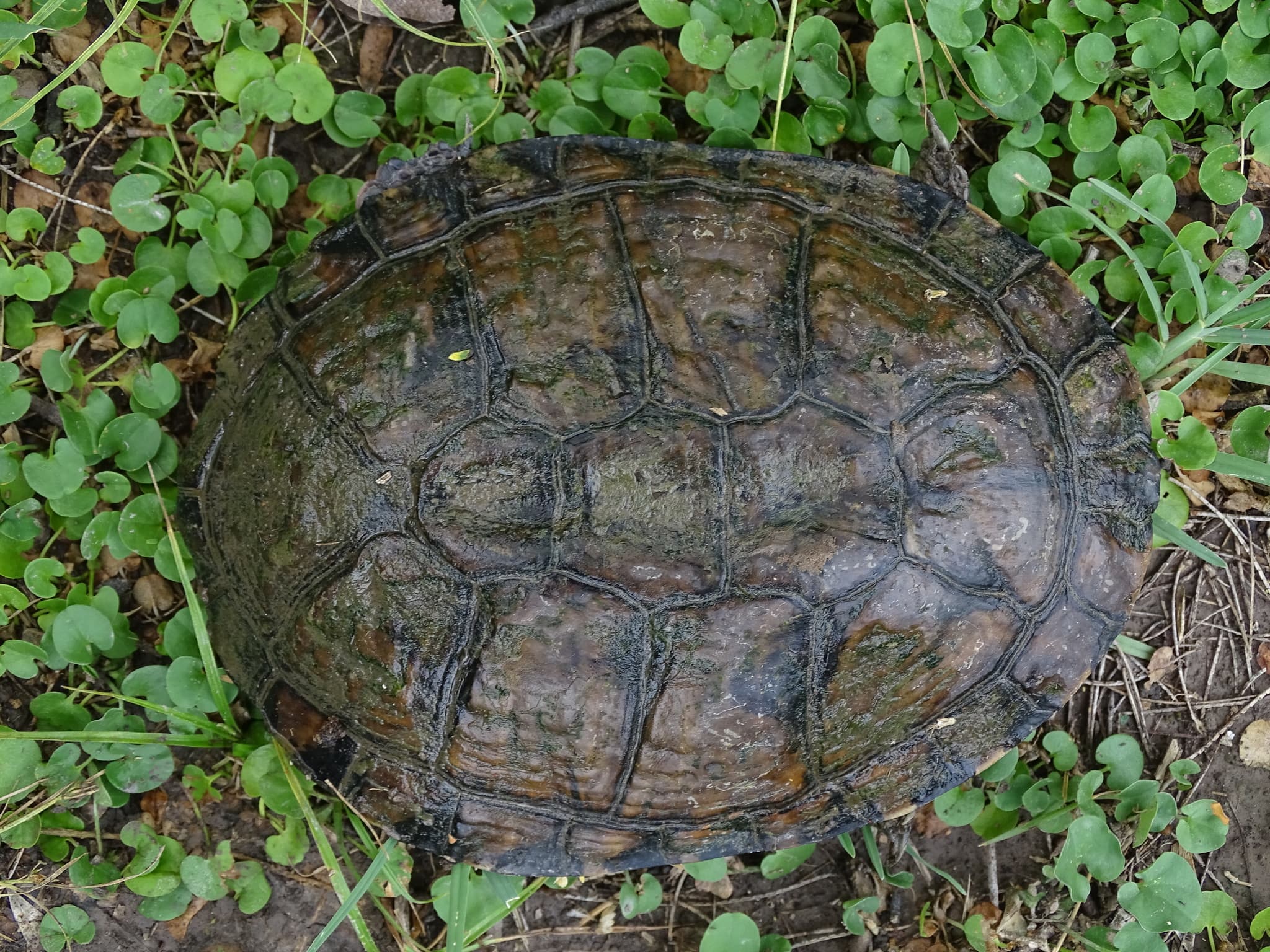
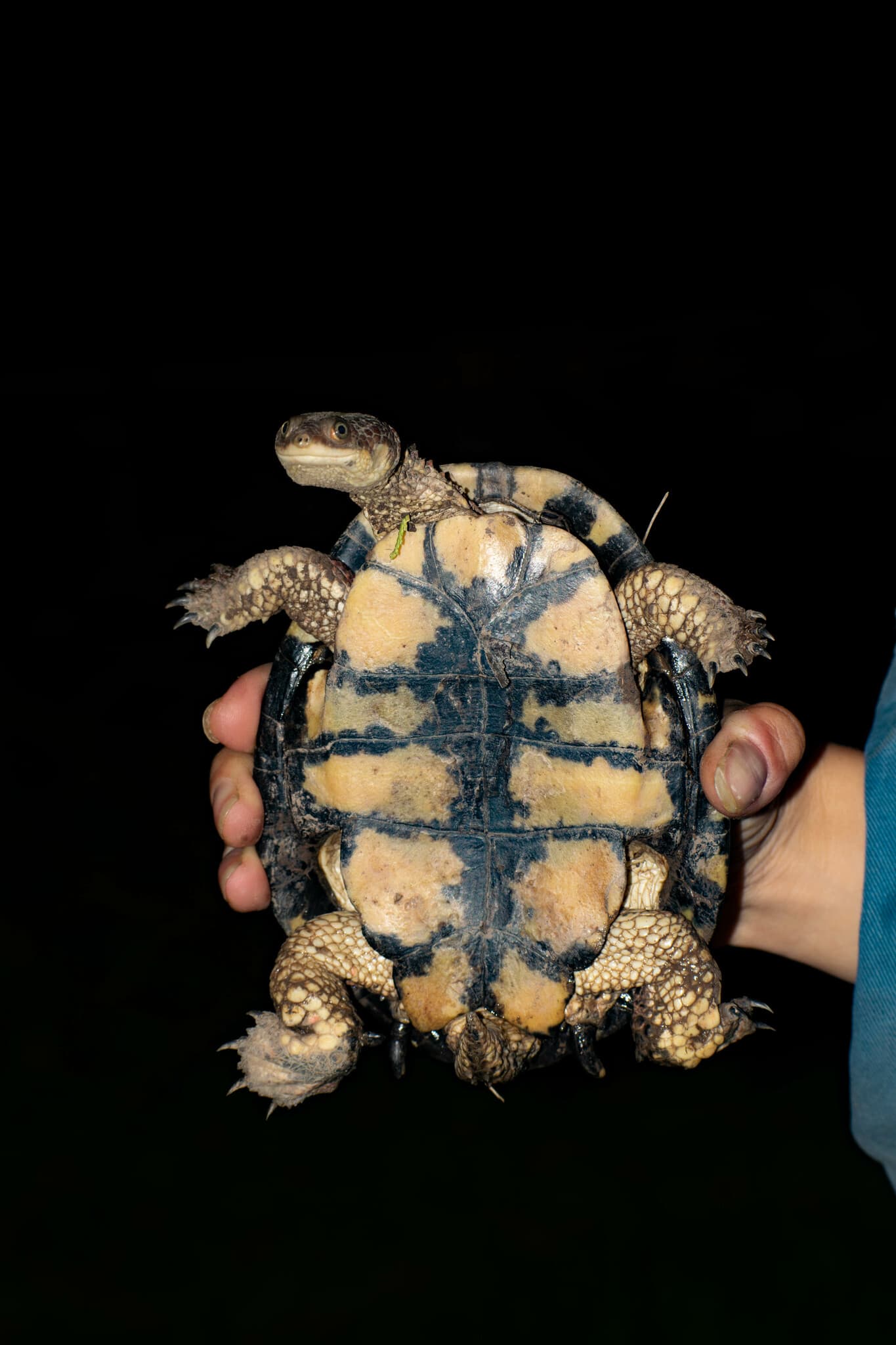
The elliptical shell is broader toward the rear and varies considerably in color—from light brown to dark brown, brownish-green, or even entirely black. Very pale individuals may show the underlying bone sutures visible through nearly transparent scutes. A shallow groove runs down the center of the shell between the first and fifth vertebral scutes. The underside is ivory yellow with black markings along the scute seams, though these dark borders can extend so much that the plastron appears almost entirely black.
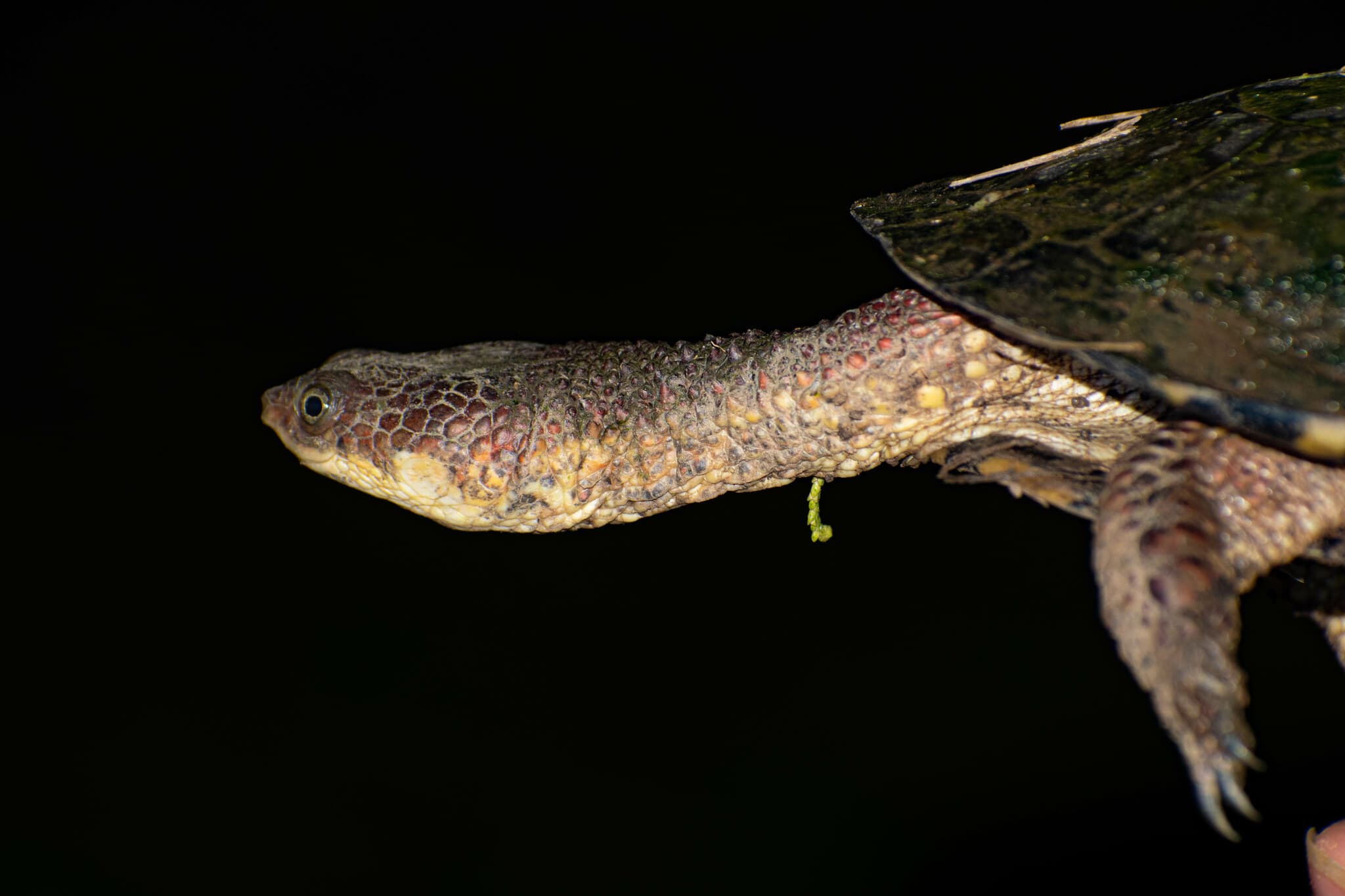
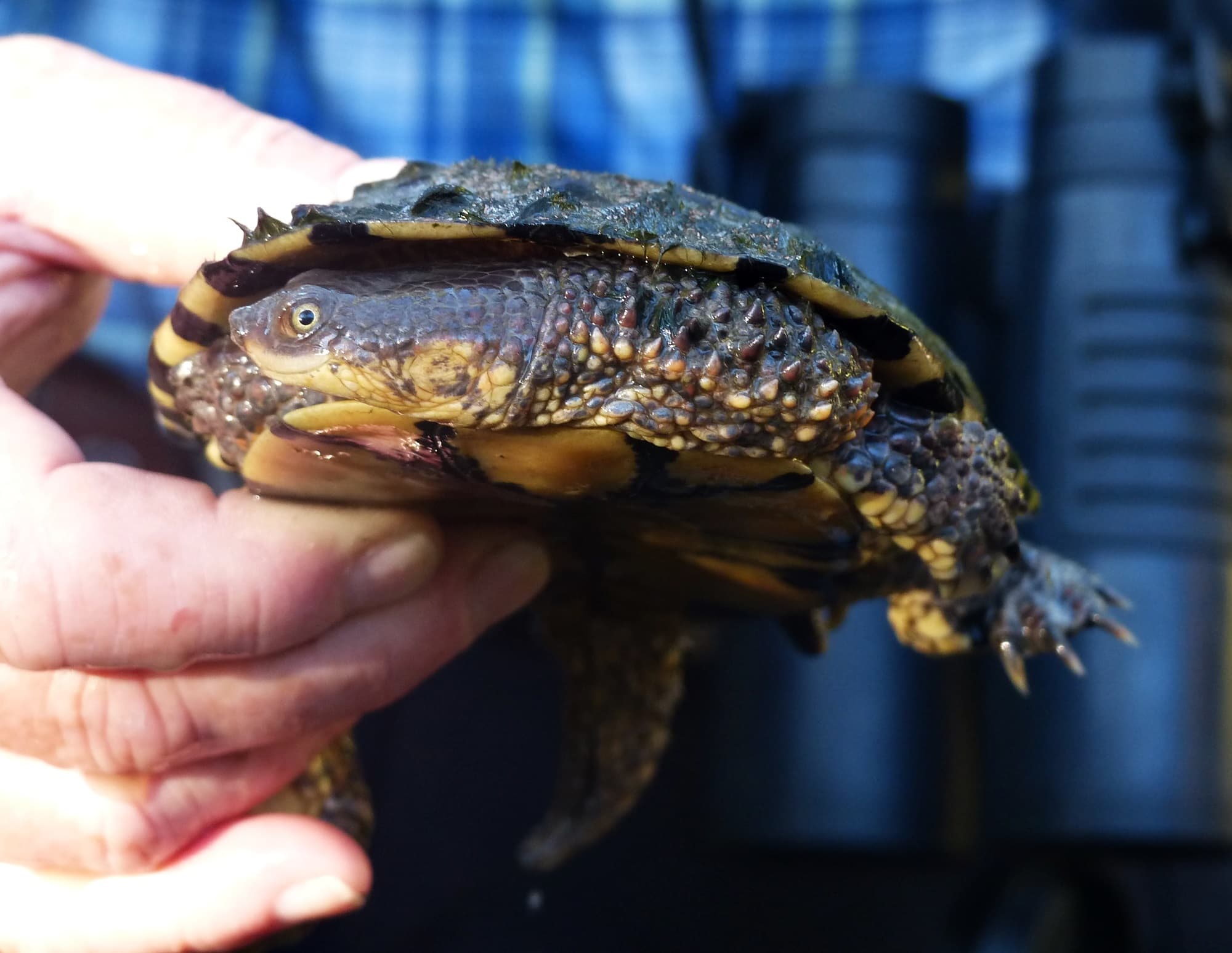
The brownish head is longer than wide and covered with irregular polygonal scales that increase in size toward the neck. Look for brilliant yellow eyes and two small chin barbels. The neck bears prominent conical tubercles, which in some individuals are red or pinkish. Face coloration varies geographically—eastern populations (Santa Fe Province) tend toward reddish-burgundy tones on the head and neck, while western Chaco populations are more brownish-yellow.
A distinctive feature is the one to three large horny spurs on the hind legs, which can reach up to 20 mm in height. The legs are short and robust with webbed feet and sharp claws.
Hatchlings measure about 31 mm and are colored to match their clay soil habitat—grayish brown on top with yellowish-orange undersides marked by small grayish-brown spots. The marginal scutes have large orange-yellow spots, with yellow or orange undersides.
Best estimate of natural adult weight based on turtles caught in the wild.
The female is generally larger than the male.
These are best estimates based on what has been observed and recorded.
Physical Features
Features shown are for Adult Males (reference). Look for the variant icon to see how a feature differs by sex or life stage.
Chaco Side-Necked Turtle
Acanthochelys pallidipectoris
Related Species | Quick Add
Distribution
The Chaco Side-Necked Turtle is strictly endemic to the Gran Chaco ecoregion of central South America, found only in the arid western portions of this vast lowland. Its range spans western Paraguay (Boquerón, Ñeembucú, and Presidente Hayes departments), southern Bolivia (Tarija), and northern Argentina (Chaco, Formosa, Salta, Santa Fe, and Santiago del Estero provinces).
A single record from Mendoza, Argentina, well outside the Chaco, almost certainly represents a released or escaped captive rather than a natural population. The species does not occur in any national park in Paraguay, and the large El Chaco Biosphere Reserve was unfortunately established entirely in the northern Chaco, outside this turtle's range. In Argentina, it has been documented in Chaco National Park.
Habitat
This turtle requires a very specific and increasingly rare habitat type: temporarily flooded marshes and lowlands within the dry shrub forest of the Gran Chaco, characterized by impenetrable clay soils. In the western Chaco, suitable habitat is largely restricted to stream beds called "cauces"—not rivers in the traditional sense, but depressions that flow only intermittently and form networks of separate flooded pools after heavy rains.
The species is both diurnal and nocturnal during its brief active season. It shares its range with the Scorpion Mud Turtle and the Chaco Tortoise, though notably not with its close relative the Big-Headed Pantanal Swamp Turtle.
Unlike its adaptable cousin A. macrocephala, which has successfully colonized artificial cattle ponds, this species cannot exploit human-modified water sources. The clay-bottomed seasonal wetlands it requires are often destroyed by ranchers who dig them out for deep water reservoirs or remove the clay soil to build elevated tanks for livestock.
Habitat Systems
Terrestrial, Freshwater
Habitat Types
Inland Wetlands, Artificial Waters, Grasslands
Predators
Specific predator information is not well documented for this species. Like most turtles, eggs and hatchlings are likely the most vulnerable life stages. The extended period of underground dormancy—up to eight months per year—may also expose aestivating turtles to predation by fossorial predators.
Adults are presumably protected by their shells, though the small population sizes and restricted habitat make any predation pressure potentially significant at the population level.
Habitat Systems
Terrestrial, Freshwater
Habitat Types
Inland Wetlands, Artificial Waters, Grasslands
Behavior
Hibernation
Rather than hibernating through winter cold, this species aestivates during the long dry season from April to September—up to eight months of dormancy each year. When water temperatures drop below 20°C, turtles leave their pools and seek shelter under bromeliads or burrow into the soil, sometimes found about 5 cm underground near tree trunks.
During aestivation, soil temperatures at dormancy sites have been recorded as low as 2–5°C, demonstrating remarkable cold tolerance for a tropical species. The turtles become active again only with the warmer rains of spring, emerging sometime between October and March for their brief 4–6 month active period.
Diet
When these turtles first emerge from months of dormancy, the temporary pools they inhabit are newly formed and lack substantial prey. During this early period, they practice neustophagia—skimming and filtering microorganisms from the water's surface. As the rainy season progresses and prey populations build up, their diet shifts to more substantial fare.
Studies of wild turtles in Mendoza found their diet consisted primarily of insects (64%, representing nine species), followed by amphibians (14%, eight species), spiders (7%), and fish (7%). Tadpoles are a favorite food. In captivity, they readily accept meat, fish, shrimp, insects, and small aquatic snails, but consistently avoid vegetables.
Nesting
The reproductive period is compressed into the short summer rainy season, from January through March. All adult females examined in one January study were gravid. Mating has been observed on land rather than in water.
Both sexes reach sexual maturity at about 130–140 mm shell length and 325–400 grams. Females produce a single clutch of 2–5 eggs per year. The eggs are hard-shelled, white, longer than wide, and measure approximately 25–28 mm by 22–24 mm.
Incubation is complex and prolonged. The only documented captive breeding success required 399 days—nearly 13 months. The eggs went through three temperature phases: 50 days at variable temperatures of 15–24°C, then 178 days at a constant 10°C (simulating the dry season cool period), followed by 171 days at 29°C before hatching. This suggests wild eggs likely overwinter in the nest before hatching coincides with the following rainy season.
Unique Traits and Qualities
The prominent horny spurs on the hind legs give this species a distinctive appearance and have generated some unfortunate folklore. Indigenous peoples in Salta Province believe these spurs are venomous, and some families report killing hatchlings on sight due to this fear—their bright orange plastral coloration apparently makes them seem even more dangerous. The species name "pallidipectoris" actually refers to the paler plastron compared to related species.
In traditional Ayoreo culture of the Bolivian Chaco, juvenile shells are fashioned into rattles by inserting a stick of palo santo wood as a clapper. Hunters wear these from their belts, using different rhythms as a communication code during hunts. The Ayoreo also carry turtle parts in shoulder bags, believing this grants them the silence and discretion of the turtle. Hispanic settlers use the shells to make charangos, a regional stringed instrument.
The species has also found use in Umbanda, an Afro-Brazilian spiritual tradition practiced in the region, where a dried hind foot is hung as a cure for asthma.
Conservation
Status
Listed as Endangered on the IUCN Red List, the Chaco Side-Necked Turtle faces a precarious future. Populations exist in extremely low numbers—even under ideal conditions after heavy rains, researchers typically find no more than three individuals across 10 square kilometers. The species has protected status in Paraguay and Argentina, and the only known Bolivian population occurs within a National Reserve.
However, these protections are clearly inadequate. The species remains consistently available in the international pet trade, indicating ongoing illegal collection. No captive breeding programs exist, and the species' demanding requirements—large terrestrial and aquatic areas, specific temperature regimes, and complex egg incubation needs—make captive propagation impractical as a conservation strategy.
IUCN Red List Status: Endangered
Environmental & Manmade Threats
Agricultural expansion is devastating this species' habitat at an alarming rate. In the Argentine Chaco, intensive soybean monoculture has transformed vast areas—660,000 hectares of native Chaco forest were cleared for soybeans between 2002 and 2006 alone, accompanied by 160 million liters of the herbicide glyphosate with no assessment of impacts on wildlife.
In Paraguay, deforestation rates in the Chaco actually increased dramatically, with allowable clearing raised from 500 to 1,500 hectares per day in 2009. Cattle ranching destroys this turtle's specialized habitat directly: ranchers prize the clay soil of stream beds for constructing water storage facilities, eliminating the very seasonal pools the turtles depend on.
Climate change compounds these threats. Droughts are becoming more frequent and severe—one drought in 2008-2009 lasted 16 months. For a species that depends entirely on seasonal rainfall to fill its temporary wetland habitat, increasingly unreliable precipitation is catastrophic.
Illegal collection for the pet trade continues despite legal protection in all three range countries. The species remains consistently available in European and American markets, indicating ongoing harvest pressure on already tiny populations.
References
- Vinke, T., Vinke, S., Richard, E., Cabrera, M.R., Paszko, L., Marano, P., and Métrailler, S. 2011. Acanthochelys pallidipectoris (Freiberg 1945) – Chaco Side-Necked Turtle. In: Rhodin, A.G.J., Pritchard, P.C.H., van Dijk, P.P., Saumure, R.A., Buhlmann, K.A., Iverson, J.B., and Mittermeier, R.A. (Eds.). Conservation Biology of Freshwater Turtles and Tortoises: A Compilation Project of the IUCN/SSC Tortoise and Freshwater Turtle Specialist Group. Chelonian Research Monographs No. 5, pp. 065.1–065.7, doi:10.3854/crm.5.065.pallidipectoris.v1.2011, http://www.iucn-tftsg.org/cbftt/.
- Vinke, T. & Vinke, S. 2016. Acanthochelys pallidipectoris. The IUCN Red List of Threatened Species 2016: e.T75A3139283. https://dx.doi.org/10.2305/IUCN.UK.2016-1.RLTS.T75A3139283.en. Accessed 14 January 2025.
- Chelonian Research Foundation. 2022. Acanthochelys pallidipectoris. The IUCN Red List of Threatened Species. Version 2025-2. https://www.iucnredlist.org. Downloaded on 14 January 2025.
- GBIF Secretariat. 2025. Acanthochelys pallidipectoris (Freiberg, 1945). GBIF Backbone Taxonomy. https://www.gbif.org/species/2441980. Accessed 14 January 2025.
- iNaturalist. 2025. Acanthochelys pallidipectoris. https://www.inaturalist.org/taxa/39612-Acanthochelys-pallidipectoris. Accessed 14 January 2025.