

Dahl's Toad-Headed Turtle
At a Glance
Dahl's Toad-Headed Turtle is a small to medium-sized freshwater turtle found only in northern Colombia, making it the only member of its family (Chelidae) living northwest of the Andes. Named for ichthyologist George Dahl who collected the first specimens in 1958, this turtle inhabits streams and pools within the highly threatened Tropical Dry Forest—a habitat that has lost more than 90% of its original cover. Listed as Critically Endangered with fewer than 200 individuals documented in the wild, the species now has its first protected area: the 120-hectare Reserva Natural La Carranchina, established in 2020.
Other Names People Call Me
Identification
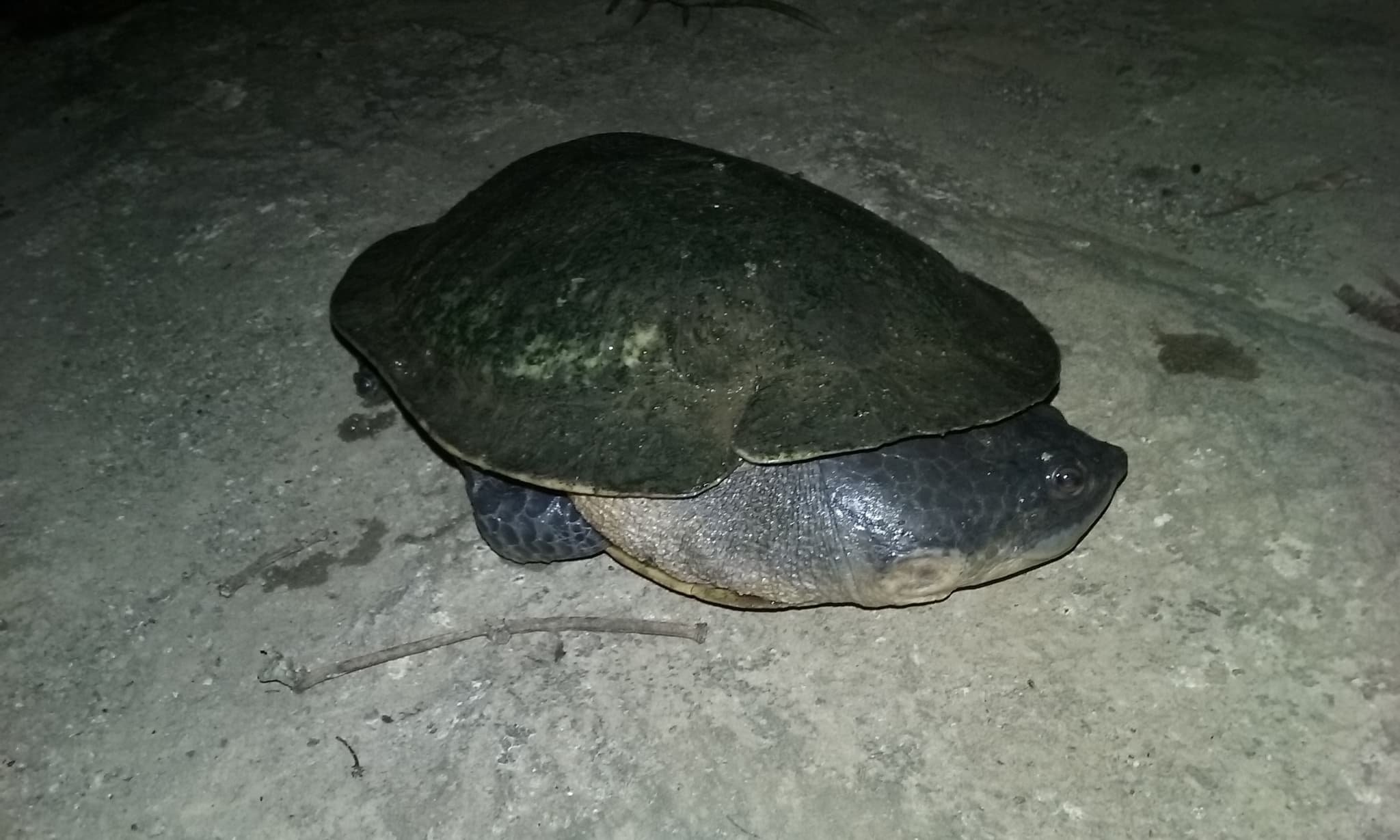
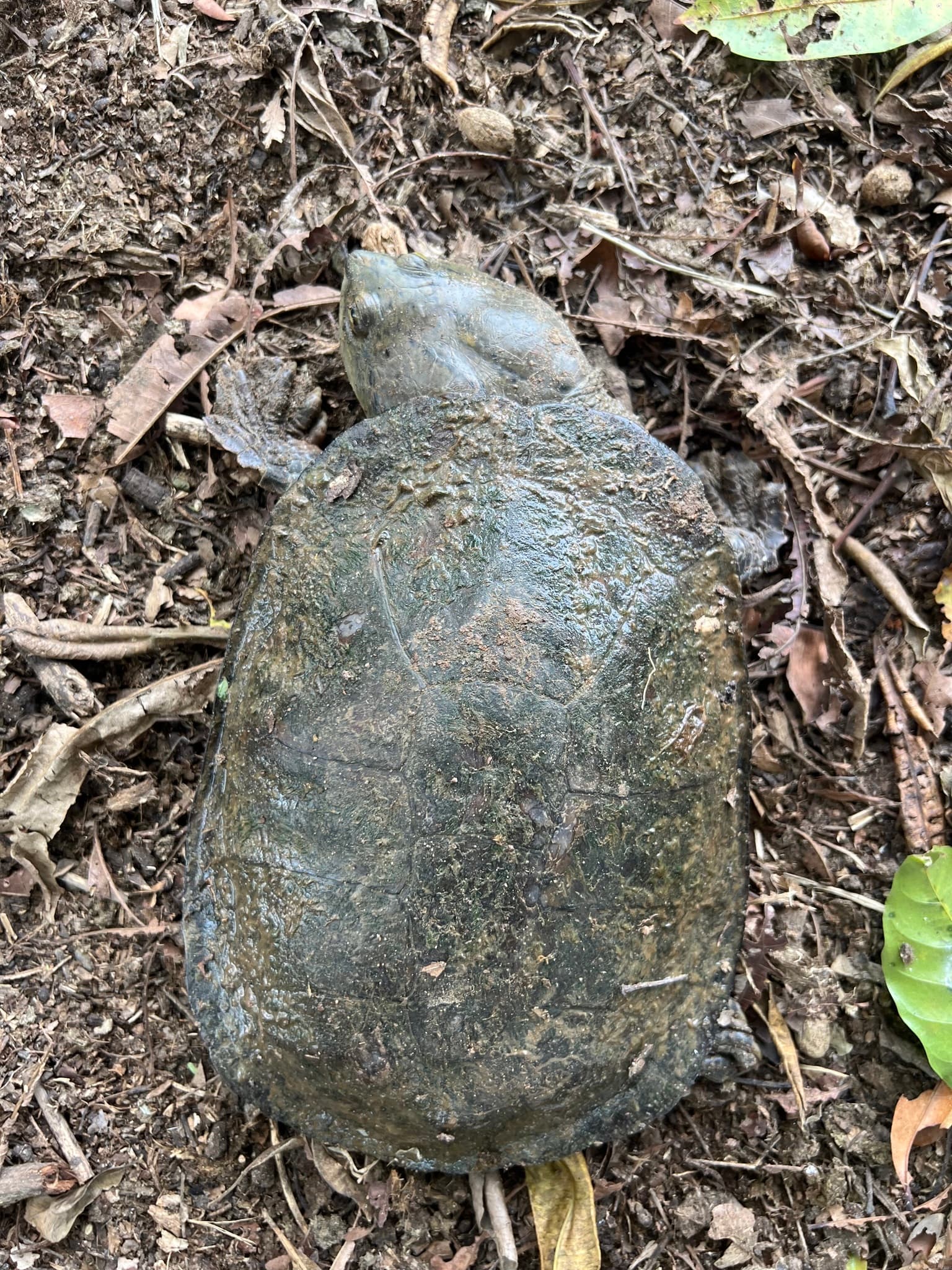
Females are noticeably larger than males, reaching nearly 30 cm in shell length compared to about 23 cm for males. The shell is compressed and olive-brown to gray, sometimes showing a faint medial keel that's most visible in juveniles. Adults develop a shallow longitudinal depression running along the middle vertebral scutes.
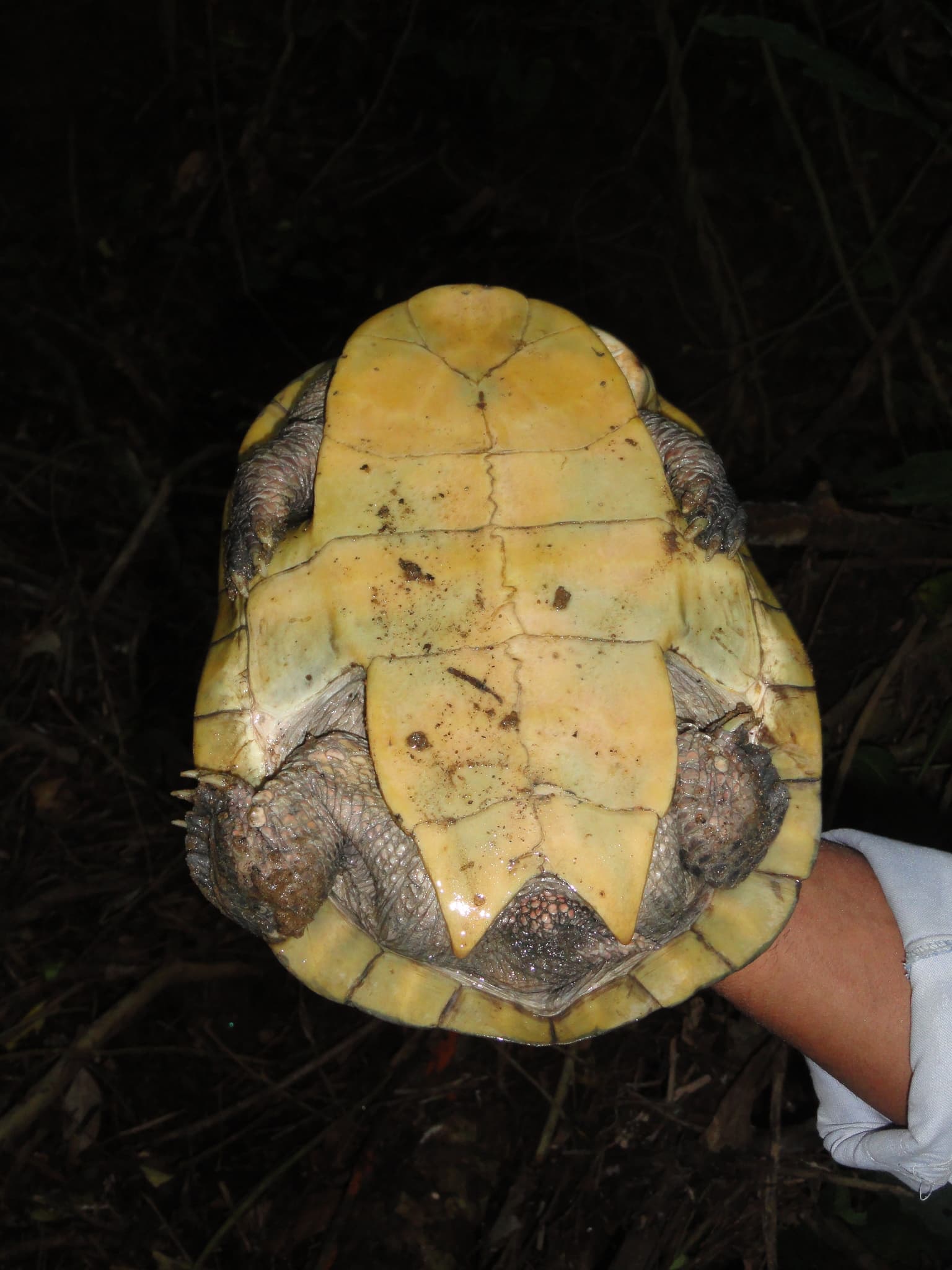
The most striking feature is the head—large, flattened, and remarkably wide at the temples due to well-developed jaw muscles. The head lacks the bony shields found in many turtles. Coloring is gray on top with light yellow or cream along the sides from nostril to ear. Two thin dark stripes run from the nostrils through the eyes and down the neck. The underside of the head, limbs, and plastron are yellow, sometimes tinged with reddish or orange tones.
Males are smaller with longer, thicker tails and a more pronounced notch at the rear of the plastron. During breeding season, males develop striking reddish coloration on the throat, neck, and forelimb scales.
Hatchlings average about 44 mm in shell length and weigh around 14 grams.
Best estimate of natural adult weight based on turtles caught in the wild.
The female is generally larger than the male.
These are best estimates based on what has been observed and recorded.
Physical Features
Features shown are for Adult Males (reference). Look for the variant icon to see how a feature differs by sex or life stage.
Dahl's Toad-Headed Turtle
Mesoclemmys dahli

Related Species | Quick Add
Distribution
This turtle is endemic to northern Colombia, restricted to a small region north of the Andes encompassing parts of six departments: Córdoba, Sucre, Atlántico, Bolívar, Magdalena, and Cesar. It was originally discovered in swamps near Sincelejo (now urbanized) and for over 40 years was known only from that small area. Recent surveys have expanded the known range considerably, and niche modeling suggests the species could potentially occur in Antioquia as well, covering roughly 32,000 km²—though most of this area has been heavily degraded.
Habitat
Dahl's Toad-Headed Turtle lives in the Tropical Dry Forest biome of northern Colombia—one of the country's most threatened and least protected ecosystems. It favors small pools and streams (both permanent and temporary) with low water flow and good vegetation cover along the edges. Studies show the species prefers first-order streams with low water clarity, widths of 1–10 meters, and deep pools with high canopy cover (greater than 82%).
The species has proven adaptable to human-altered landscapes. Individuals regularly turn up in swamps, artificial farm ponds, and temporary pools that form in open pastures during the rainy season. However, this adaptability has limits—the loss of riparian vegetation causes pools to overheat and dry out, eliminating critical habitat.
Habitat Systems
Terrestrial, Freshwater
Habitat Types
Inland Wetlands, Artificial Waters
Predators
Adults face predation from Spectacled Caimans and small cats. Various raptors and large birds target different life stages: Southern Caracaras, Snail Kites, and Great Black Hawks take adults, while herons, storks, and various hawks and eagles prey on juveniles and hatchlings. The Gold Tegu (a large lizard) preys on both eggs and adults. Nests are also raided by Crab-eating Raccoons and tegus.
The months spent buried during estivation may expose turtles to predators they wouldn't encounter in water, though specific data on this vulnerability is lacking.
Habitat Systems
Terrestrial, Freshwater
Habitat Types
Inland Wetlands, Artificial Waters
Behavior
Hibernation
Rather than hibernating through winter, this species estivates during the dry season—a crucial adaptation for surviving in a landscape where water bodies can disappear for months. When streams dry up, turtles leave the water and bury themselves under leaf litter, tree roots, or spiny shrubs. They've been found estivating as far as one kilometer from the nearest water and can remain buried for up to 120 days.
To survive this extended dormancy, the turtles retain large amounts of water in their bladders to prevent desiccation. Groups of individuals sometimes estivate close together, though they don't all appear to begin dormancy at the same time—researchers have found thin, empty-stomached turtles alongside well-fed individuals with algae still growing on their shells.
Diet
This species is an opportunistic omnivore that feeds primarily at night while in the water. The diet centers on snails (particularly apple snails), crustaceans, crabs, aquatic insects, tadpoles, frogs, small fish, and carrion, with occasional plant material. The large head and powerful jaw muscles appear well-suited for crushing snail shells. Interestingly, researchers have found ants in the stomachs of estivating individuals, suggesting they may also feed on land when the opportunity arises.
Nesting
Reproductive ecology remains poorly understood in wild populations. Captive observations suggest mating occurs primarily in June and July in shallow water. In Córdoba, egg-laying takes place during the dry months from October to March, with hatchlings emerging between April and May.
Females may nest considerable distances from water—one nest was found about a kilometer from the nearest stream. Clutch size appears variable, with reports ranging from 6 to 12 eggs. Eggs are nearly spherical, measuring roughly 34 x 29 mm and weighing about 16 grams. Under captive conditions, incubation lasts approximately four months with high hatching success (92%). The presence of eggs at various developmental stages in females suggests the species may produce multiple clutches per year.
Unique Traits and Qualities
This turtle holds a unique biogeographic distinction as the only member of the side-necked turtle family Chelidae found northwest of the Andes—all other South American chelids occur east of this mountain range. Genetic studies have revealed a close relationship with Mesoclemmys zuliae from Venezuela, though the two remain distinct species despite their weak genetic divergence.
The species shows remarkable site flexibility, with annual home ranges spanning 9 to 31 hectares. Individuals may use or cross streams, riparian forest, pastures, and isolated pools in open areas. During the transition from rainy to dry season, some turtles make substantial movements—likely searching for suitable estivation sites or more permanent water bodies.
Conservation
Status
Listed as Critically Endangered on the IUCN Red List, this species faces an increasingly precarious future. While surveys since 2000 have expanded its known range to six Colombian departments, genetic research has revealed troubling findings: the population is fragmented into at least six isolated subpopulations with dangerously high levels of inbreeding. Only about 131 individuals have been documented across the species' entire range.
A major conservation milestone came in 2020 when WCS Colombia, the Turtle Survival Alliance, and Rainforest Trust established Reserva Natural La Carranchina—the first and only protected area for this species. This 120-hectare reserve in San Benito Abad (Sucre) serves as a recovery ground where scientists are implementing a genetic rescue strategy, bringing together unrelated individuals from different population clusters to increase genetic diversity.
Additional conservation efforts include community-based programs in Chimichagua (Cesar), where agreements with nine landowners now protect 394 hectares and over 8,000 native trees have been planted since 2017. Environmental education programs in local schools raise awareness about this endemic species among future generations.
IUCN Red List Status: Critically Endangered
Environmental & Manmade Threats
Habitat destruction poses the greatest threat. The Tropical Dry Forest has been devastated by deforestation—less than 10% of original cover remains in the Colombian Caribbean. Riparian vegetation along streams has been eliminated in most areas, causing pools to overheat and dry up prematurely.
Fire is a particularly serious concern—artificial burns set for agriculture cause direct mortality in adults and destroy nests. One study found that a quarter of turtles examined bore burn scars. Additional threats include chemical pollution of waterways, urban expansion (the original type locality near Sincelejo is now covered by the city), agricultural conversion, cattle ranching, and plastic ingestion in aquatic habitats.
Local pressures also take a toll. Some fishermen kill turtles caught incidentally, sometimes decapitating them to recover fishing gear. Indigenous communities hunt them, and locals trade them for food. As populations of other turtle species like the Colombian slider decline, carranchinas are increasingly harvested as an alternative food source. The species is also illegally trafficked, with shells sold for handicrafts. A few residents kill any turtles they find, believing they prey on domestic poultry.
References
- Forero-Medina, G., Castaño-Mora, O.V., Cárdenas-Arevalo, G., and Medina-Rangel, G.F. 2013. Mesoclemmys dahli (Zangerl and Medem 1958) – Dahl's Toad-Headed Turtle, Carranchina, Tortuga Montañera. In: Rhodin, A.G.J., Pritchard, P.C.H., van Dijk, P.P., Saumure, R.A., Buhlmann, K.A., Iverson, J.B., and Mittermeier, R.A. (Eds.). Conservation Biology of Freshwater Turtles and Tortoises: A Compilation Project of the IUCN/SSC Tortoise and Freshwater Turtle Specialist Group. Chelonian Research Monographs No. 5, pp. 069.1–069.8, doi:10.3854/crm.5.069.dahli.v1.2013, http://www.iucn-tftsg.org/cbftt/.
- Tortoise & Freshwater Turtle Specialist Group. 1996. Mesoclemmys dahli. The IUCN Red List of Threatened Species 1996: e.T17082A6793547. https://www.iucnredlist.org/species/17082/6793547. Accessed 21 January 2025.
- Gallego-García, N., Vargas-Ramírez, M., Forero-Medina, G., and Caballero, S. 2017. Genetic evidence of fragmented populations and inbreeding in the Colombian endemic Dahl's toad-headed turtle (Mesoclemmys dahli). Conservation Genetics 19:221–233. doi:10.1007/s10592-017-1021-z.
- Forero-Medina, G., Cárdenas-Arevalo, G., and Castaño-Mora, O.V. 2012. Habitat modeling of Dahl's toad-headed turtle (Mesoclemmys dahli) in Colombia. Herpetological Conservation and Biology 7(2):313–322.
- Forero-Medina, G., Cárdenas-Arevalo, G., and Castaño-Mora, O.V. 2011. Abundance, home range, and movement patterns of the endemic species Dahl's toad-headed turtle (Mesoclemmys dahli) in Cesar, Colombia. Chelonian Conservation and Biology 10(2):228–236. doi:10.2744/CCB-0929.1.
- GBIF Secretariat. 2025. Mesoclemmys dahli (Zangerl & Medem, 1958). GBIF Backbone Taxonomy. https://www.gbif.org/species/2442071. Accessed 21 January 2025.
- iNaturalist. 2025. Dahl's Toad-headed Turtle (Mesoclemmys dahli). https://www.inaturalist.org/taxa/73863-Mesoclemmys-dahli. Accessed 21 January 2025.