

Orinoco Mata Mata
At a Glance
The Orinoco Mata Mata is one of the world's most bizarre-looking turtles—a master of disguise with a flattened, leaf-shaped head covered in skin flaps and a rough, bark-like shell that makes it virtually invisible among fallen leaves on dark river bottoms. Split from its Amazonian sibling species in 2020 after genetic studies revealed the two had been evolving separately for around 13 million years, this turtle inhabits the Orinoco River basin and parts of the upper Rio Negro in northern South America. While its conservation status hasn't been formally assessed since being recognized as a distinct species, growing international demand for these strange-looking turtles in the pet trade has raised concerns.
This species profile contains limited information and may be incomplete. Some sections may be missing data or require further research.
Other Names People Call Me
Identification
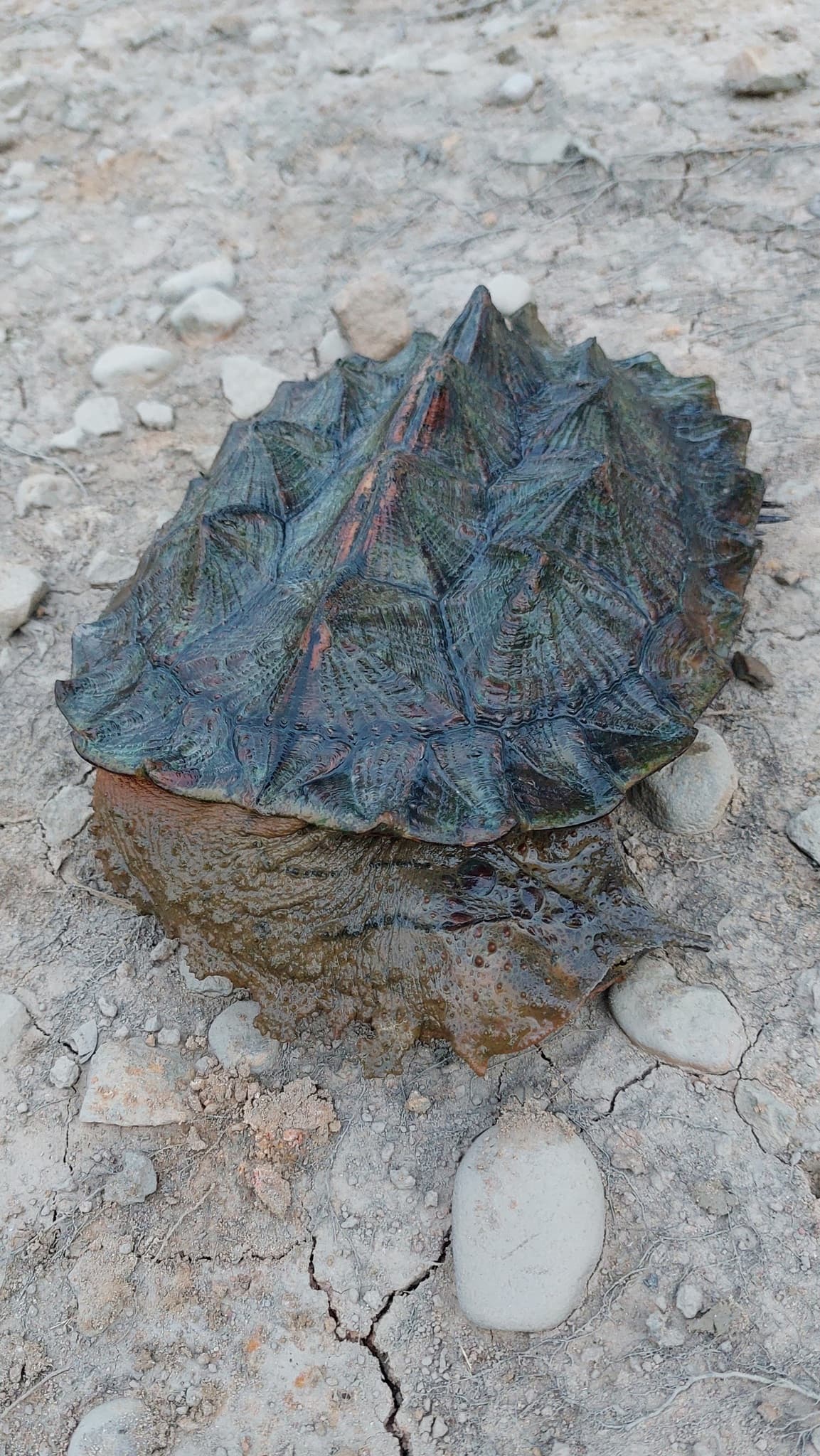
This large freshwater turtle can reach over 50 cm in shell length, with females growing considerably larger than males. The shell is broad and low with an oval outline, dark in color, and covered in three rows of knobby tubercles that give it a rough, bark-like texture—perfect camouflage among leaf litter.
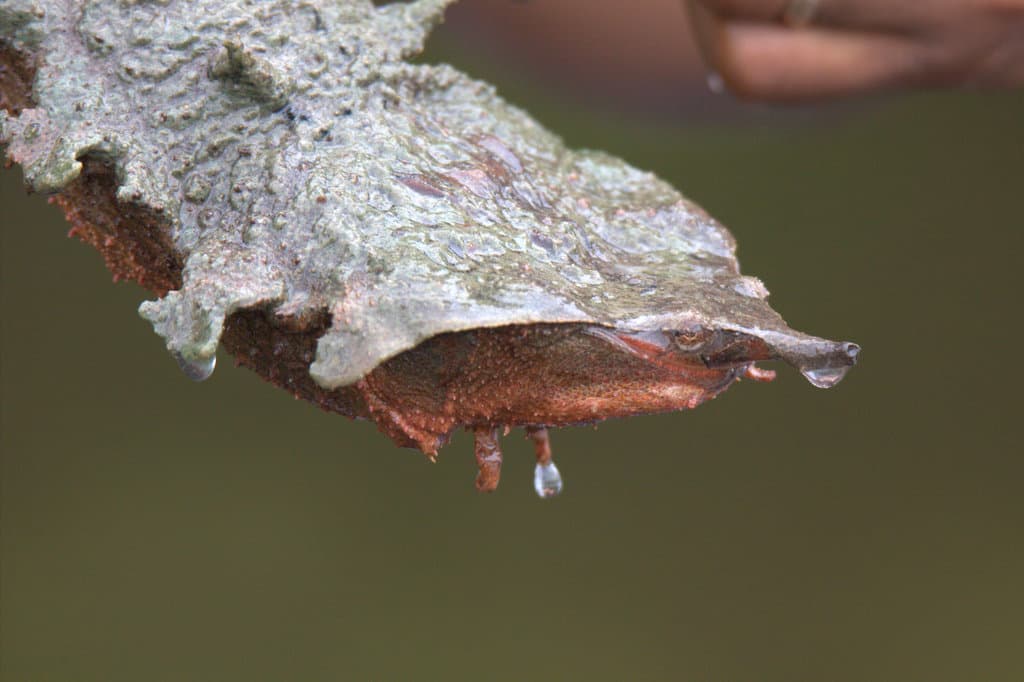
But it's the head that makes this turtle unmistakable. Extremely wide and flattened like a triangle, it features a long tubular snout tipped with nostrils, tiny eyes positioned far forward, and an enormously wide mouth. Fringed skin flaps drape from the sides of the head and run along the thick, muscular neck. Two small barbels hang beneath the chin.
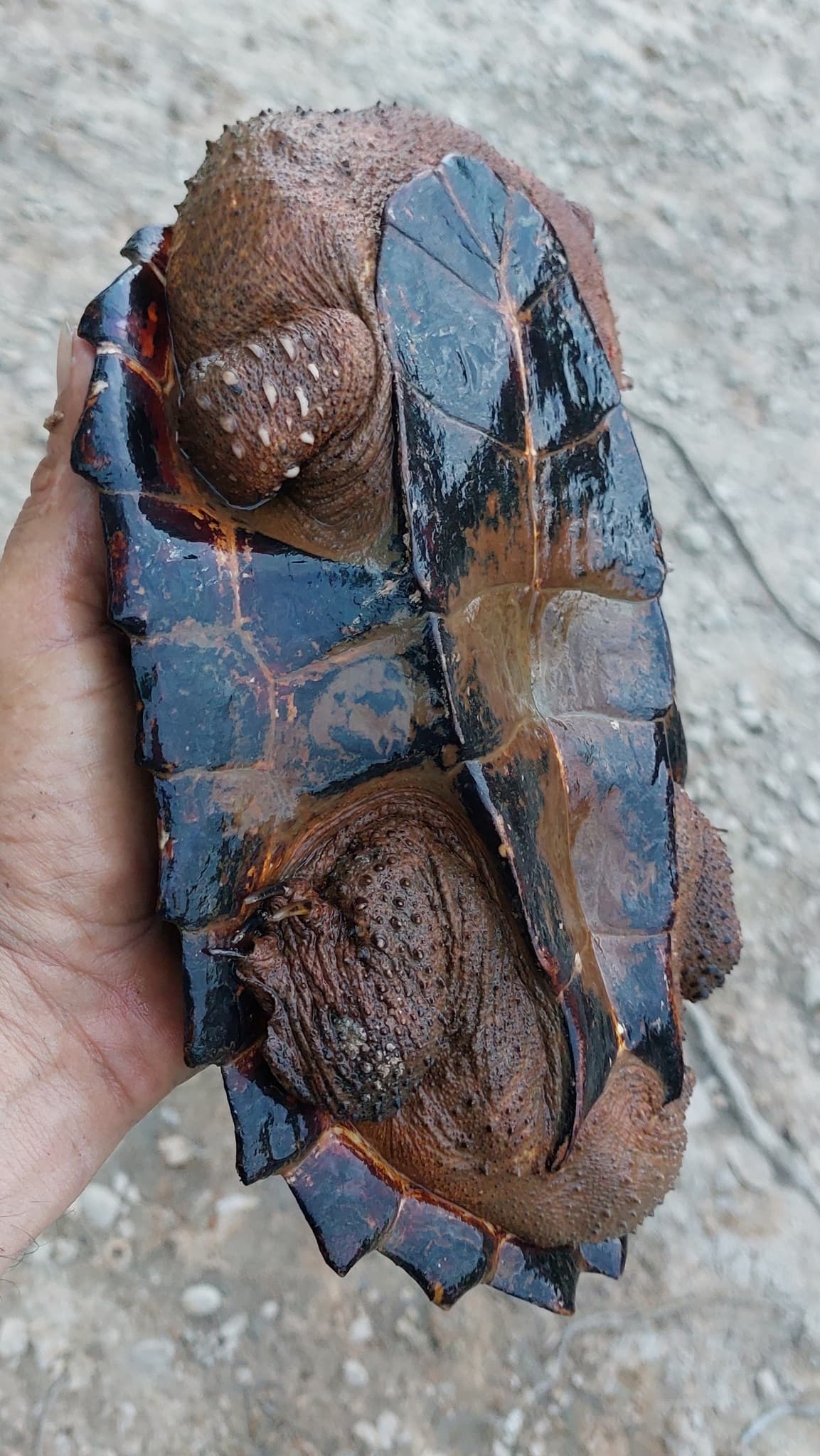
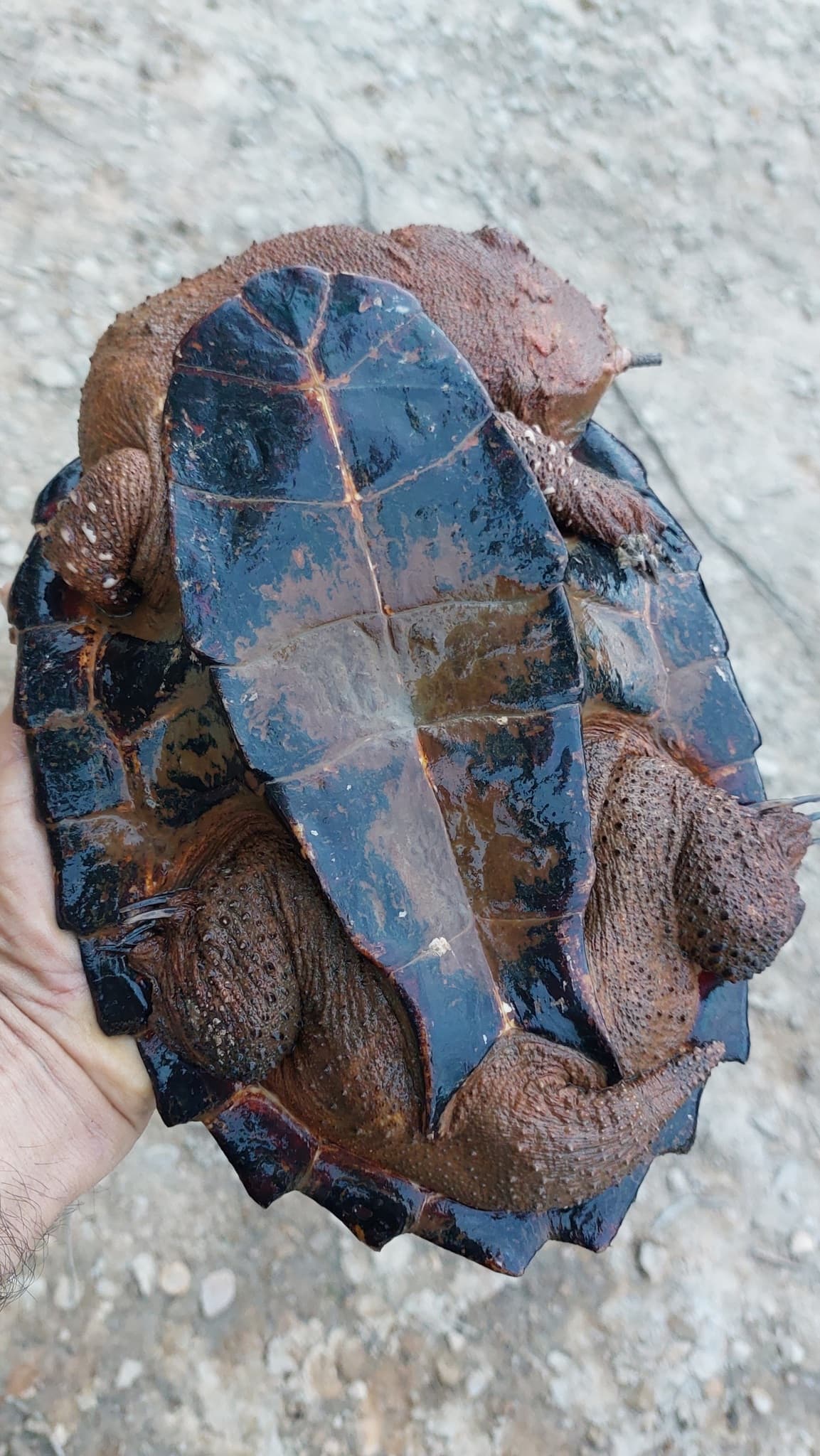
The key way to distinguish this species from its Amazon relative is coloration: the Orinoco Mata Mata has a pale, unpigmented plastron (yellowish) rather than a darkly pigmented one, and the underside of the neck is often bright pink with little to no dark markings, unlike the bold black stripes seen in Amazon specimens. The shell tends to be more oval rather than rectangular.
Best estimate of natural adult weight based on turtles caught in the wild.
The female is generally larger than the male.
These are best estimates based on what has been observed and recorded.
Physical Features
Features shown are for Adult Males (reference). Look for the variant icon to see how a feature differs by sex or life stage.
Orinoco Mata Mata
Chelus orinocensis
Related Species | Quick Add
Distribution
The Orinoco Mata Mata occupies a more restricted range than was historically attributed to the matamata as a single species. Its core distribution includes the Orinoco River basin in Colombia and Venezuela, extending into the upper Rio Negro and Rio Branco systems in northern Brazil (which, despite being Amazon tributaries, are inhabited by this species rather than the Amazon Mata Mata).
The species also occurs in the Essequibo River system of Guyana. Interestingly, specimens occasionally wash up on Trinidad's coast after being carried out of the Orinoco Delta by currents—some have been found alive bearing barnacles, suggesting they survived marine conditions for weeks. Whether breeding populations exist on Trinidad remains unverified.
Habitat
These are strictly aquatic turtles that live on the bottom of slow-moving or still waters—oxbow lakes, quiet river inlets, swamps, and flooded forests with muddy bottoms and abundant leaf litter. They prefer shallow water where they can easily reach the surface to breathe without swimming, as they are surprisingly weak swimmers for such an aquatic species.
In the Venezuelan llanos, they favor isolated pools and water bodies that form during the dry season when water levels drop. They seem equally at home in forested areas and open savannah river habitats. While they occasionally turn up at the mouths of rivers or even in brackish coastal waters—sometimes washing up alive on Trinidad's shores after being carried out of the Orinoco Delta—these are essentially freshwater animals. The murky, sediment-laden waters of their habitat provide ideal conditions for their ambush hunting strategy.
Habitat Systems
Terrestrial, Freshwater
Habitat Types
Inland Wetlands
Predators
Predation data for this species is limited due to its cryptic nature. Giant river otters are known to prey on adult matamatas in Guyana, sometimes bringing them ashore and killing them. Eggs are likely vulnerable to tegu lizards (Tupinambis teguixin), which have been identified as the main natural predator of matamata eggs in Venezuela.
Fish like piranhas may cause minor injuries—in one Venezuelan study, most adult matamatas captured showed healed mutilations (missing toes, occasionally feet or cephalic skin flaps), potentially inflicted by the abundant piranha sharing their habitat. Hatchlings and juveniles are presumably more vulnerable to a wider range of aquatic and terrestrial predators, though specific predation records are lacking.
Habitat Systems
Terrestrial, Freshwater
Habitat Types
Inland Wetlands
Behavior
Hibernation
Mata matas don't hibernate in the traditional sense. These tropical turtles remain active year-round in their warm, equatorial habitat. However, their activity levels likely fluctuate with seasonal changes in water levels. In the Venezuelan llanos, where dramatic wet-dry seasonal cycles occur, turtles may become concentrated in shrinking pools during the dry season, making them temporarily more visible to observers. During high water periods, they disperse into flooded forests and become much harder to find.
Diet
Mata matas are specialized ambush predators that feed almost exclusively on live fish. They sit motionless on murky river bottoms, their camouflaged bodies blending with dead leaves, waiting for prey to swim within range. The elaborate skin flaps on their head are highly sensitive to water movements, allowing them to detect approaching fish even in total darkness.
When prey comes close enough, the turtle strikes with explosive speed—thrusting its head sideways while simultaneously opening its cavernous mouth and expanding its throat. This creates a powerful suction that vacuums the fish into its mouth along with a rush of water, which is then expelled as the prey is swallowed whole. In French Guiana, the characin fish Erythrinus erythrinus (typically 20–25 cm long) is commonly taken prey. While fish dominate the diet, they may occasionally take aquatic invertebrates, and some sources suggest small birds or mammals that enter the water could be taken opportunistically.
Nesting
Nesting occurs in the early dry season, typically October through December, when water levels begin to drop. Females seek out sandy or clayey banks rather than open beaches, often climbing steep riverbanks in a sideways fashion to reach suitable nest sites.
The nest is dug to about 10 cm depth using the hind legs, and females deposit 12–28 nearly spherical, hard-shelled eggs measuring 34–40 mm in diameter. The eggs require an exceptionally long incubation period—often around 200 days in captivity, though wild incubation may be faster, possibly triggered by contact with rising floodwaters. Hatchlings emerge at roughly 49 mm shell length and weigh 15–19 g.
Sexual maturity is reached at approximately 5–7 years. Males display a more concave plastron than females and have longer tails with more distally positioned vents. Courtship behavior in captivity involves the male approaching the female, making head movements, and synchronized swimming before mating.
Unique Traits and Qualities
Everything about the mata mata is extreme. That bizarre, flattened head with its dangling skin flaps isn't just for show—each flap is packed with nerve endings that detect the slightest water movements, essentially creating a highly sensitive motion-detection array. The tiny eyes are almost irrelevant; this turtle hunts by feel in waters too murky to see through.
The feeding strike is one of nature's most dramatic. The turtle can expand its throat so rapidly that it creates a vacuum, sucking in fish along with a rush of water. The massive hyoid apparatus (throat bones) and heavily muscled neck power this suction feeding—a technique so effective that captive matamatas have been observed herding fish into corners before striking.
Perhaps most remarkable is the species' divergence from its Amazon relative: the two lineages separated approximately 13 million years ago during the late Miocene, around the time the Orinoco Basin was forming as a distinct drainage system. Despite living so close geographically, they've been on separate evolutionary paths longer than humans and chimpanzees.
Conservation
Status
The Orinoco Mata Mata has not yet received a formal IUCN assessment as a distinct species—it was only described in 2020 when genetic analysis split the matamata into two species. Previously, all matamata populations were assessed together as Least Concern based on their broad distribution, but that assessment dates to 1996 and is considered outdated.
The separation into two species means the geographic range of each is now smaller than previously thought, potentially increasing vulnerability. In 2022, CITES parties voted to include both Chelus species in Appendix II, recognizing that international trade regulation is needed to ensure harvesting doesn't threaten wild populations.
Export of matamatas is prohibited in Colombia, Venezuela, and Brazil, though enforcement varies. The species occurs in several protected areas across Venezuela, including Parque Nacional Delta del Orinoco, Parque Nacional Santos Luzardo, and Parque Nacional Aguaro-Guariquito.
IUCN Red List Status: Not Evaluated
Environmental & Manmade Threats
International trade poses the primary conservation concern for this species. Young matamatas are highly sought after by aquarium enthusiasts and reptile collectors in Europe, the United States, and especially China. In Peru (where legal export of Chelus is permitted), exports increased from 749 individuals in 2010 to nearly 20,000 in 2018. Significant seizures of smuggled matamatas—sometimes thousands of hatchlings in a single shipment—have occurred at Colombian airports, with animals apparently being trafficked to Peru for legal export.
The challenge now is distinguishing between the two species in the trade. Genetic analysis shows that C. orinocensis specimens from the Colombian Orinoco basin have been mixed into shipments labeled as C. fimbriata, complicating enforcement and potentially masking the true harvest pressure on each species.
Habitat degradation from pollution, mining, and deforestation affects water quality throughout much of the range. Proposed waterway development projects in the Orinoco and Amazon basins could alter flooding patterns that these turtles depend on for nesting habitat. Local consumption for food occurs but is generally limited—most rural people find matamatas too strange-looking and malodorous to eat when other turtle species are available.
References
- Vargas-Ramírez, M., Caballero, S., Morales-Betancourt, M.A., Lasso, C.A., Amaya, L., Martínez, J.G., Silva Viana, M.N., Vogt, R.C., Farias, I.P., Hrbek, T., Campbell, P.D., & Fritz, U. 2020. Genomic analyses reveal two species of the matamata (Testudines: Chelidae: Chelus spp.) and clarify their phylogeography. Molecular Phylogenetics and Evolution 148: 106823. doi:10.1016/j.ympev.2020.106823
- Pritchard, P.C.H. 2008. Chelus fimbriata (Schneider 1783) – matamata turtle. In: Rhodin, A.G.J., Pritchard, P.C.H., van Dijk, P.P., Saumure, R.A., Buhlmann, K.A., and Iverson, J.B. (Eds.). Conservation Biology of Freshwater Turtles and Tortoises: A Compilation Project of the IUCN/SSC Tortoise and Freshwater Turtle Specialist Group. Chelonian Research Monographs No. 5, pp. 020.1–020.10, doi:10.3854/crm.5.020.fimbriata.v1.2008, http://www.iucn-tftsg.org/cbftt/.
- Cunha, F.A.G., Camila, A.G., Fagundes, K., Brito, E.S., Vogt, R.C., Maffei, F., Pezzuti, J., Félix-Silva, D., Rojas-Runjaic, F.J.M., Lasso, C.A., Morales-Betancourt, M.A., Tadeu de Carvalho, V., & Valsecchi do Amaral, J. 2021. Distribution of Chelus fimbriata and Chelus orinocensis (Testudines: Chelidae). Chelonian Conservation and Biology 20(1): 109–115. doi:10.2744/CCB-1398.1
- Brazil, Colombia, Costa Rica, Peru. 2022. Consideration of Proposals for Amendment of Appendices I and II: Proposal to include Chelus fimbriata and Chelus orinocensis in Appendix II. CoP19 Prop. 22 (Rev. 1). CITES Nineteenth Meeting of the Conference of the Parties, Panama City.
- TTWG [Turtle Taxonomy Working Group]. 2021. Turtles of the World: Annotated Checklist and Atlas of Taxonomy, Synonymy, Distribution, and Conservation Status (9th Ed.). Chelonian Research Monographs 8: 1–472. doi:10.3854/crm.8.checklist.atlas.v9.2021.
- Uetz, P., Freed, P., Aguilar, R., Reyes, F., Kudera, J. & Hošek, J. (eds.). 2025. Chelus orinocensis. The Reptile Database. http://www.reptile-database.org/species?genus=Chelus&species=orinocensis. Accessed 21 January 2025.