

Suwannee Alligator Snapping Turtle
At a Glance
The Suwannee Alligator Snapping Turtle is a formidable freshwater predator found only in the Suwannee River drainage of northern Florida and southern Georgia. Males can grow to enormous sizes—occasionally exceeding 50 kg—making this one of the largest freshwater turtles in North America. Described as a distinct species in 2014, it now faces federal protection as Threatened under the U.S. Endangered Species Act and is listed as Vulnerable on the IUCN Red List, with fishing gear entanglement and declining water quality posing the most immediate threats to its survival.
Other Names People Call Me
Identification
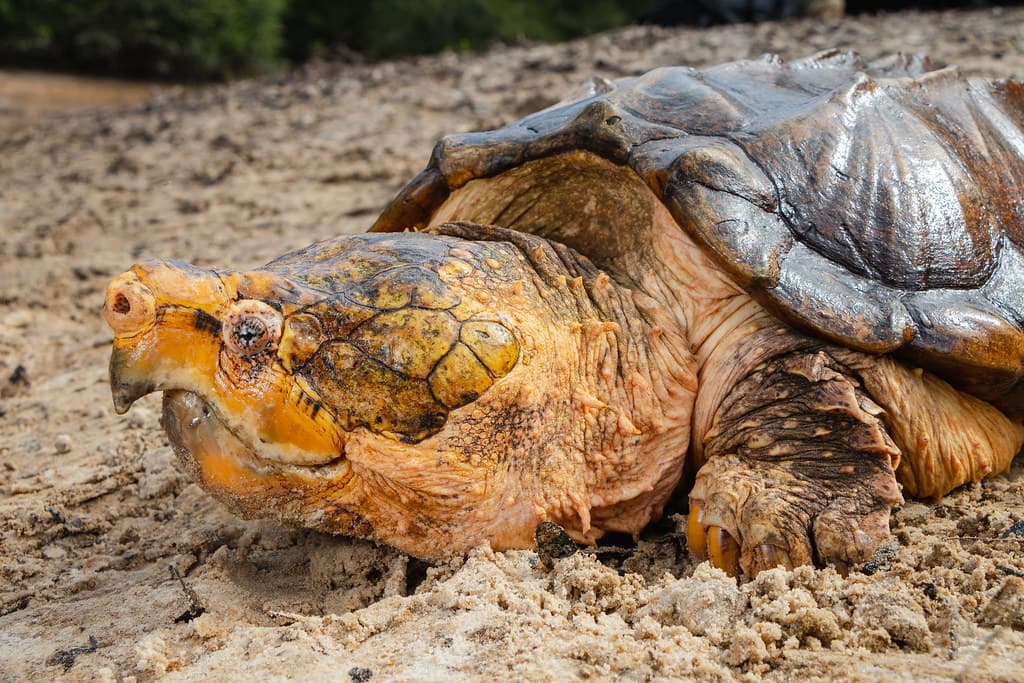
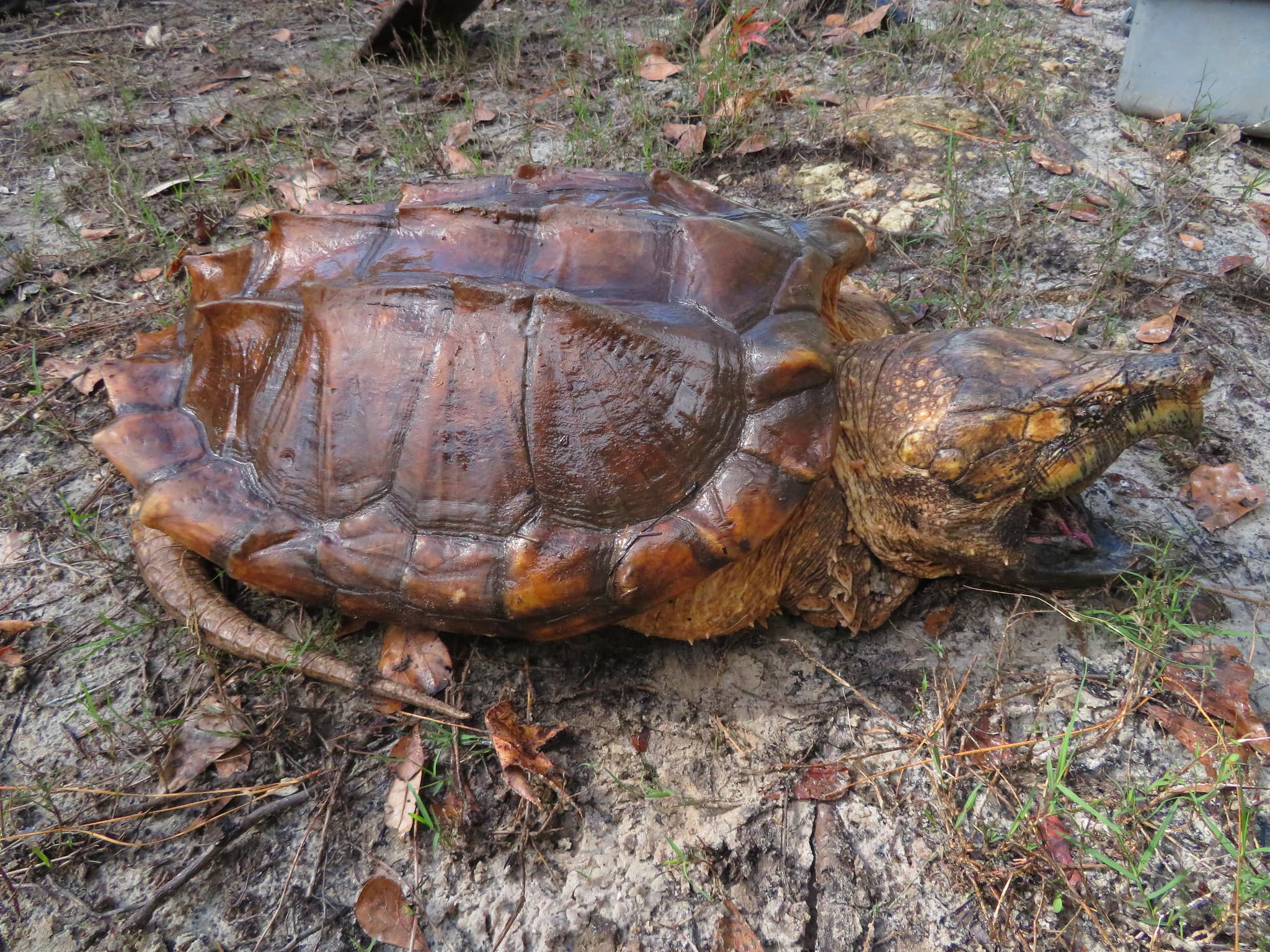
Males are dramatically larger than females, reaching two to three times their size—up to about 65 cm in shell length and 58 kg in the wild, compared to roughly 49 cm and 26.5 kg for the largest females. The carapace has three prominent longitudinal keels that curve posteriorly, giving the shell a rugged, prehistoric appearance. These ridges are very pronounced in juveniles but become smoother with age. A row of extra scutes (supramarginals) sits between the marginal and costal scutes, and the posterior edge of the shell is serrated.
The head is massive and roughly triangular from above, with powerful hooked jaws and laterally placed eyes that have conical protuberances above and below. Inside the mouth sits a wormlike lingual lure used to attract prey. In hatchlings, this lure is bright red against a dark, speckled mouth lining. As turtles age, the mouth lightens to pink or white, though the jaw lining may remain black, and the lure becomes less vivid—typically pink, gray, or white.
The carapace of hatchlings and juveniles is dark brown, sometimes lightening to gray-brown or yellowish-brown in adults. Young turtles have soft bumps, flaps, and papillae on their dark skin; these cornify with age, and the skin becomes wrinkled. Adult skin and plastron are light brown, grayish tan, or ivory, and the heads of large males and some females become completely or partially yellow. The long tail bears three rows of tubercles on top and small scales below.
Best estimate of natural adult weight based on turtles caught in the wild.
The male is generally larger than the female.
These are best estimates based on what has been observed and recorded.
Physical Features
Features shown are for Adult Males (reference). Look for the variant icon to see how a feature differs by sex or life stage.
Suwannee Alligator Snapping Turtle
Macrochelys suwanniensis

Related Species | Quick Add
Distribution
The Suwannee Alligator Snapping Turtle is endemic to the Suwannee River watershed, which drains about 28,500 km² across northern peninsular Florida and south-central Georgia. It occupies the mainstem Suwannee River and most of its major tributaries—the Santa Fe, Alapaha, and Withlacoochee rivers—along with numerous smaller streams. However, it is naturally rare in the extreme upper Suwannee and Okefenokee Swamp and virtually absent from the lower estuary where salinity fluctuates. An introduced population has also been documented in the Homosassa River south of the native range.
Habitat
This species inhabits the rivers, streams, and adjacent floodplain swamps, ponds, and lakes of the Suwannee drainage. The Suwannee River itself changes dramatically along its course, and turtle populations respond accordingly. The dark, acidic upper river supports fewer and smaller turtles, while the mineral-rich middle river—where groundwater from the Floridan Aquifer transforms the water chemistry—supports the highest densities and the largest males.
Turtles strongly prefer habitats with underwater structure, particularly submerged woody debris and undercut banks, regardless of overhead canopy cover. During floods, they move laterally from the river channel into inundated floodplains to exploit new foraging opportunities. When water levels drop, submerged logs in the main channel become critical refugia. The species also occurs in spring-fed rivers like the Santa Fe and Ichetucknee, as well as the blackwater Alapaha and Withlacoochee rivers in Georgia.
Habitat Systems
Freshwater, Terrestrial
Predators
Raccoons are likely the primary nest predators, and red imported fire ants may threaten embryos and emerging hatchlings. American Alligators probably prey on smaller turtles, and carapacial pitting on some individuals appears to be from alligator tooth marks. In the lower Suwannee River, marine predators such as sharks may also pose a risk. Adult turtles are well-protected by their massive shells and powerful jaws, but hatchlings and juveniles are far more vulnerable. Leeches are common external parasites, and the blood parasite Haemogregarina macrochelysi—transmitted by leeches—has been detected in all individuals sampled.
Habitat Systems
Freshwater, Terrestrial
Behavior
Hibernation
This species does not truly hibernate or aestivate. It remains active year-round in the upper and middle Suwannee River, though activity likely decreases at low water temperatures. Captive individuals ceased feeding below about 18°C, and capture rates drop in winter. That said, active individuals have been observed snorkeling at night in the Santa Fe River during January and February at water temperatures of 16–20°C, and turtles have been captured in baited traps in December. Aerial basking is extremely rare—only a single observation of a juvenile basking in partial sunlight has been documented.
Diet
These turtles are opportunistic omnivores with a diet that shifts as they grow. Adults consume mostly fish—particularly sunfish—along with smaller amounts of crayfish, snails, plants, and macroalgae. They've been documented eating remarkably varied fare, including acorns, persimmon seeds, wild grapes, pawpaw fruits, green algae, musk turtle bones, and even a complete nine-banded armadillo skeleton. Juveniles rely more heavily on crayfish and small fish, which they lure into striking distance using their wormlike tongue appendage.
Adults are opportunistic scavengers and active nocturnal foragers, moving upstream from bank to bank in shallow water, periodically probing the substrate with their heads to smell out food. Interestingly, about 35% of persimmon seeds recovered from their feces germinated, suggesting these turtles may play a role as seed dispersers in their river ecosystem.
Nesting
Much about the reproductive biology of this species remains poorly understood. Captive turtles courted from February through April, and the first wild mating observation occurred in December—the earliest mating ever recorded for any alligator snapping turtle. Male combat involving wrestling and head-biting has been observed in September, October, and December, suggesting the breeding season may be more prolonged than previously thought.
Nesting occurs from late March through mid-May, with females selecting partially open, sandy areas such as sandhill habitat, river bluffs, sand roads, and residential yards within 15–78 m of water. Known clutch sizes range from 16 to 47 eggs, with a mean of about 35—similar to the closely related Western Alligator Snapping Turtle. Eggs average about 38 mm in diameter and 31 g. Hatching likely occurs in August or September after roughly 100–110 days of incubation, with nest temperatures determining the sex of hatchlings: 25–27°C produces mostly males, while 29–30°C produces only females.
Sexual maturity is estimated at about 19 years for females and 22 years for males, and females likely produce only one clutch per year, with some occasionally skipping years.
Unique Traits and Qualities
What sets this species apart starts with its evolutionary isolation. Split from other alligator snapping turtles millions of years ago, the Suwannee population was recognized as a distinct species in 2014 based on genetic and morphological differences—including a uniquely wide, lunate-shaped notch at the back of the shell and a skull that is nearly as wide as it is long.
The wormlike lingual lure is perhaps the most famous feature of alligator snapping turtles. This pink appendage on the floor of the mouth is wiggled to attract curious fish into the gaping jaws—a sit-and-wait strategy that juveniles use masterfully. The lure's color can change over time and even between encounters, shifting among red, pink, gray, and white depending on blood flow and pigmentation.
The species' response to the Suwannee River's unusual geology is also remarkable. Population structure, body size, and sex ratios shift dramatically along the river as water chemistry transitions from acidic blackwater to mineral-rich, spring-fed conditions—providing a natural laboratory for understanding how environment shapes turtle populations.
Conservation
Status
Listed as Vulnerable on the IUCN Red List and federally Threatened under the U.S. Endangered Species Act since July 2024, this species has strong legal protections in place. Florida prohibited commercial harvest of alligator snapping turtles in 1972 and all take in 2009; Georgia banned harvest in 1989 and listed the species as Threatened in 1992. The species is also included in CITES Appendix II.
A capture-recapture study estimated roughly 1,200–2,700 individuals in the mainstem Suwannee River, with very high adult survival rates of 0.99 per year. However, population models suggest the trend is uncertain—possibly stable or slightly declining. The high proportion of large males in the Suwannee indicates the drainage was likely spared from the commercial overharvest that devastated other alligator snapping turtle populations elsewhere. Even so, because the population is highly sensitive to adult mortality, even small increases in deaths could trigger decline.
IUCN Red List Status: Vulnerable
Environmental & Manmade Threats
The most immediate threat is incidental mortality from fishing activities. About 15% of radiographed turtles had fishing hooks lodged in their throats or gastrointestinal tracts, where they can perforate the digestive lining or cause fatal blockages. Entanglement in passive fishing gear like trotlines, bush hooks, and bank lines can drown turtles, and abandoned gear continues to pose a hazard with the river's fluctuating water levels.
Over the longer term, declining water availability is the most serious concern. Groundwater levels in the Floridan Aquifer have dropped over the past 70 years due to increased extraction and reduced recharge. Drought frequency in the Suwannee drainage has increased tenfold since the mid-1990s, and reduced spring flows threaten water clarity and primary productivity. Water pollution from agricultural runoff, sewage spills, and elevated nitrate and mercury levels compounds these problems. The removal of submerged "deadhead" logs from the river—permitted by Florida since 2000—also threatens this species, since woody debris is its primary habitat feature.
References
- Thomas, T.M., Enge, K.M., Stevenson, D.J., and Johnston, G.R. 2025. Macrochelys suwanniensis Thomas, Granatosky, Bourque, Krysko, Moler, Gamble, Suarez, Leone, Enge, and Roman 2014 – Suwannee Alligator Snapping Turtle. In: Rhodin, A.G.J., Iverson, J.B., van Dijk, P.P., Stanford, C.B., Goode, E.V., Buhlmann, K.A., and Mittermeier, R.A. (Eds.). Conservation Biology of Freshwater Turtles and Tortoises: A Compilation Project of the IUCN/SSC Tortoise and Freshwater Turtle Specialist Group. Chelonian Research Monographs 5(19):133.1–20. doi:10.3854/crm.5.133.suwanniensis.v1.2025; www.iucn-tftsg.org/cbftt/.
- Thomas, T.M., Enge, K.M., and Johnston, G.R. 2025. Macrochelys suwanniensis. The IUCN Red List of Threatened Species 2025: e.T232768492A232768500. Accessed 9 February 2026.
- GBIF Secretariat. 2025. Macrochelys suwanniensis. GBIF Backbone Taxonomy. https://www.gbif.org/species/8336846. Accessed 9 February 2026.
- iNaturalist. 2026. Macrochelys suwanniensis. https://www.inaturalist.org/taxa/521317. Accessed 9 February 2026.
- Thomas, T.M., Granatosky, M.C., Bourque, J.R., Krysko, K.L., Moler, P.E., Gamble, T., Suarez, E., Leone, E., Enge, K.M., and Roman, J. 2014. Taxonomic assessment of alligator snapping turtles (Chelydridae: Macrochelys), with the description of two new species from the southeastern United States. Zootaxa 3768(2):141–165.
- Thomas, T.M., Enge, K.M., Suarez, E., and Johnston, G.R. 2022. Population status of the Suwannee alligator snapping turtle (Macrochelys suwanniensis) in the Suwannee River. Chelonian Conservation and Biology 21:2–10.
- Thomas, T.M., Enge, K.M., Suarez, E., Barry, S.C., and Johnson, S.A. 2023. Variation in population structure, body size, and relative abundance of the Suwannee alligator snapping turtle (Macrochelys suwanniensis) in the Suwannee River. Southeastern Naturalist 22(Special Issue 12):264–274.
- Thomas, T.M., Enge, K.M., Suarez, E., Schueller, P., Bankovich, B., and Leone, E.H. 2024. Home range and habitat selection of the Suwannee alligator snapping turtle (Macrochelys suwanniensis) in the Suwannee River, Florida. Chelonian Conservation and Biology 22(2):146–155.
- Johnston, G.R., Thomas, T.M., Suarez, E., Lau, A., and Mitchell, J.C. 2015. Population structure and body size of the Suwannee alligator snapping turtle (Macrochelys suwanniensis) in northern Florida. Chelonian Conservation and Biology 14:73–81.
- U.S. Fish and Wildlife Service. 2024. Endangered and threatened wildlife and plants; threatened status for the Suwannee alligator snapping turtle with a Section 4(d) rule. Federal Register 89:53507–53528.
- Wikipedia contributors. 2025. Suwannee alligator snapping turtle. Wikipedia, The Free Encyclopedia. https://en.wikipedia.org/wiki/Suwannee_snapping_turtle. Accessed 9 February 2026.